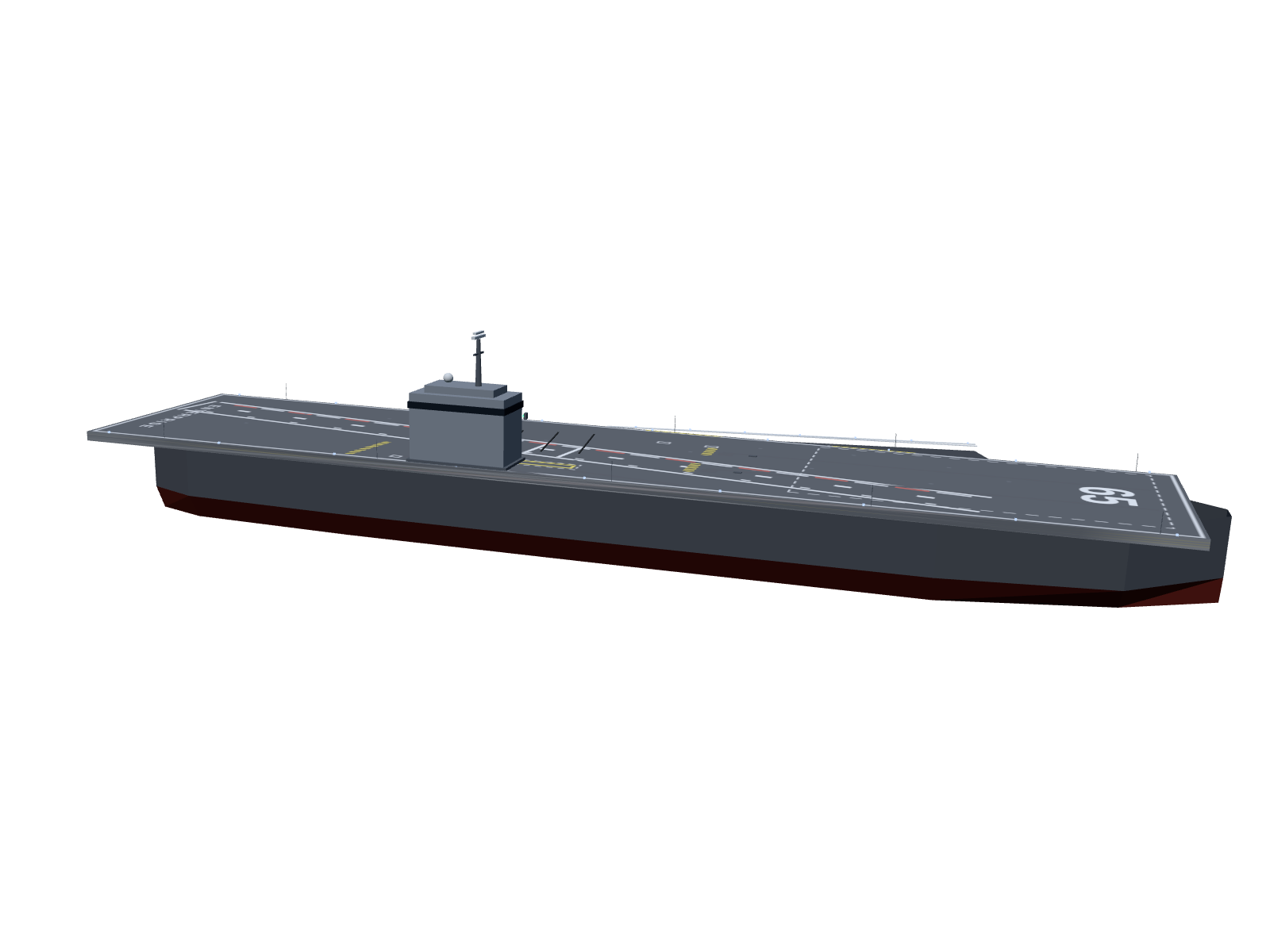
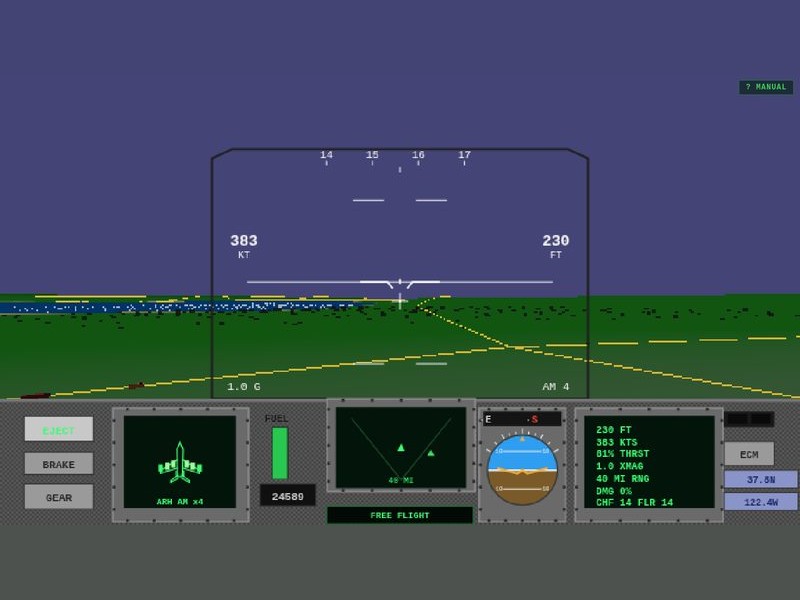
The Big E is where every Hornet Bay sortie begins and ends: a 342-metre angled-deck carrier with Cat 1 reserved for you, Cat 2 for the air wing, and a meatball guiding you to the 3-wire.
Every sortie in Hornet Bay starts and, if you follow the rules, ends in the same place: a 342-metre slab of grey steel doing a steady course through the bay. The Print Bay lists her at a real length of 342 m, and she is the one ship in the sim that matters more than any other, because she is your point of origin.
What you are standing on
USS Enterprise was the Navy’s first nuclear-powered carrier, commissioned in 1961. In the sim she is the home plate: a flat-top with a boxy, flat-roofed island and a landing strip angled off to port, as covered in the angle deck post and the island rebuild. The hull number, 65, is painted big on the deck.
In the sim
Cat 1 is yours. You taxi to the shuttle, ride the holdback, and the cockpit tells you “CAT 1 HOLDBACK — 90% THRUST FOR THE SHOT” before the stroke flings you off the bow.
Cat 2 belongs to the air wing. The starboard bow cat launches the squadron’s jets while you wait your turn, and the yellow shirts work both shooters.
The landing strip is the angled deck. Wires, meatball and aim point all derive from the same strip geometry, so what you see is what you trap on.
The meatball rides the port edge and shows you the 3.5° glideslope. Come aboard with gear or hook up and the red wave-off lamps flash.
The 3-wire is the one the air wing aims for: their jets flare to catch it, and the wire stops a 62 m/s arrival in about two seconds.
Escorts and a model for your desk
She never sails alone. Four station-keeping escorts hold a picket around her, and the cruiser ahead is also in the Print Bay, along with the Big E herself: scaled to 250 mm long, six angles of her on the shelf.
One standing rule applies, and it is the reason she matters: a mission only counts as complete when you return to the point of origin. Land at another airfield and you can rearm and refuel, but you still have to come home.
Try this: take off from the carrier, circle once, then fly the break and put the meatball in the centre of the row. Do it three times and you will never look at a runway the same way.
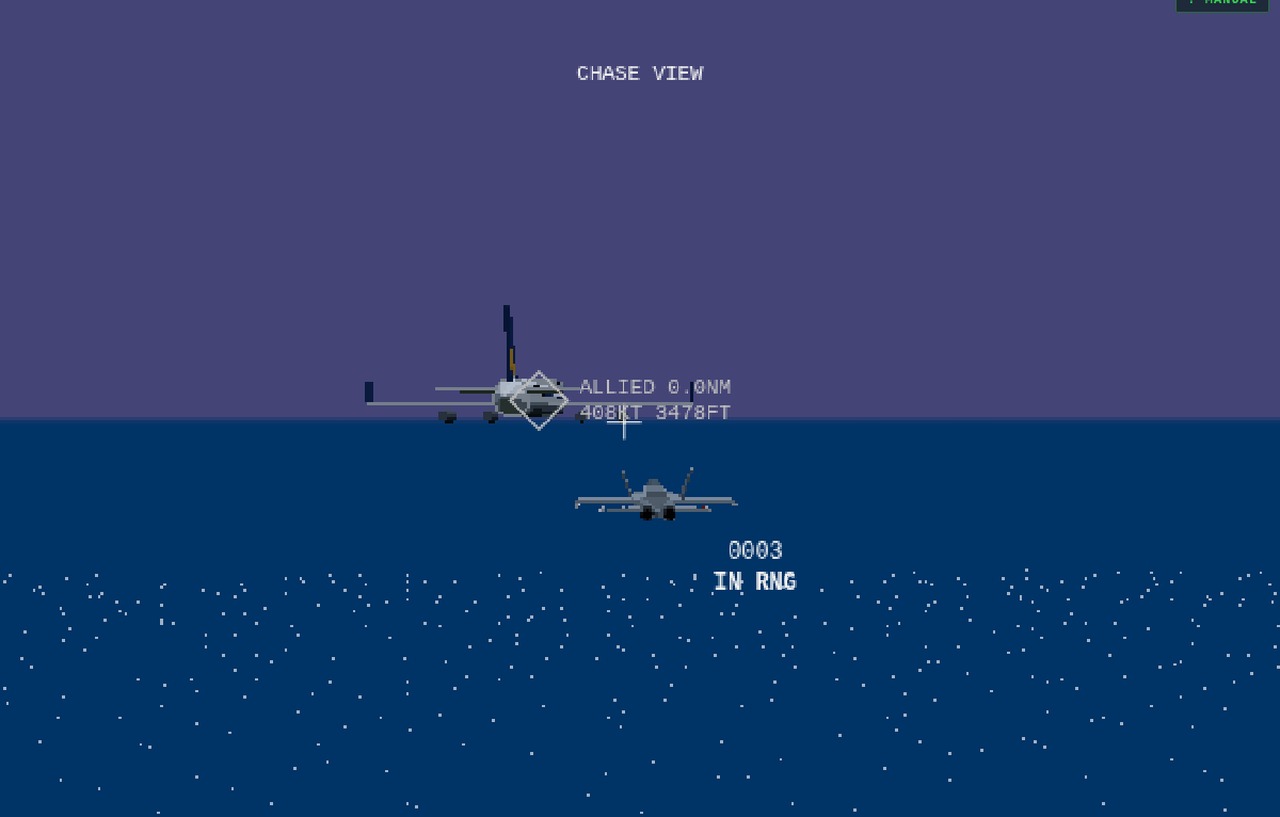
The mail was short: take the civilian airliners off the target list. Done — and then some. An airliner is still a contact on the scope, still traffic in the pattern, still a 747 full of people climbing out of SFO. What it is not, any longer, is anything your weapons will touch.
No lock. The target cycler steps past civil traffic now. T walks you through every bandit in the sky and never once stops on an airliner — no diamond, no tone, no SHOOT cue. Civilian contacts paint the scope; they don’t enter the firing solution.
No bullet, no warhead. Even a stray refuses: the Vulcan won’t track an airliner, an unguided round won’t detonate against one, and any damage that somehow arrives is waved off at the door. Guns, missiles, bombs — the whole inventory respects it.
No court martial, because no crime. The old check-fire shout and the wings-forfeit ending went out with the trigger — you can’t commit the offence, so the law came off the books. Enemy guns can still hurt the friendlies you escort, so the defector and NAVY 1 keep their stakes.
The pattern is full of people going about their day. Now they’re untouchable — the way it always should have been. — HB
A five-line punch list from the cockpit, worked line by line. First, the roads: by day they were rendering in a loud yellow — fine for a centreline at midnight, wrong for asphalt under the California sun. Road ribbons are now dark asphalt gray with muted gray edge lines and centre dashes, still dimming with the sun at dusk, and from altitude they read as proper highways again instead of glowing spaghetti. The menu footer grew too: the HornetBay YouTube channel and a contact address (maverick@hornetbay.com) now sit alongside the journal and X links.
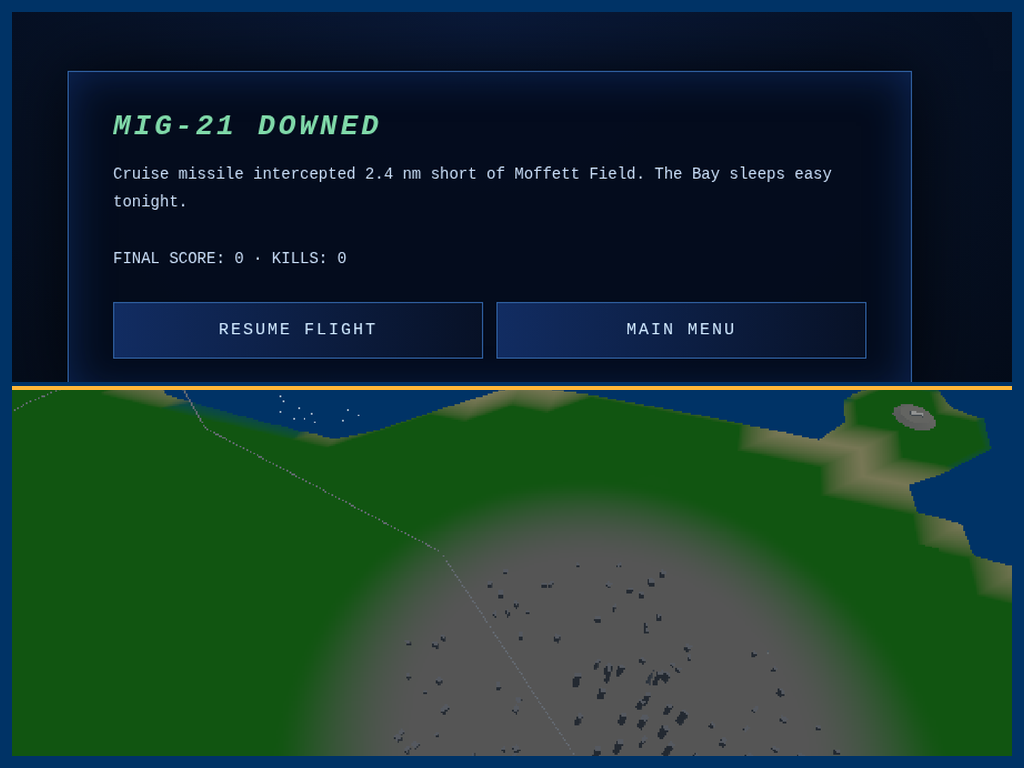
The nastiest item was a trap waiting after mission success: bag the cruise missile bound for Moffett, read the MISSION SUCCESS debrief, close it — and the main menu slammed down over the world with no way back to your jet. The debrief simply never handed control back to the sim. Now it does: a RESUME FLIGHT button (or Enter, Space or Escape) folds the debrief away and drops you straight back into free flight over the world you just saved; MAIN MENU remains if you’re done for the day. Chasing this one exposed a sneakier accomplice — the service worker’s cache could pin an old build, so fixes weren’t always reaching installed copies. The worker now revalidates with the server on every load: what ships is what you fly.
And maritime law is now enforced: every ship, boat and pleasure craft stays in the blue water, never on the green. The traffic routes had been plotted against the wrong chart datum — the sea surface sits a touch below the terrain’s zero mark, so two legs that looked wet on paper actually clipped a drying shoreline and parked sailboats on the Sausalito shallows. Every route was re-plotted against the game’s own ground truth with the corrected waterline and a wide safety margin, then swept waypoint by waypoint. Twelve hulls, all wet, all day and night.
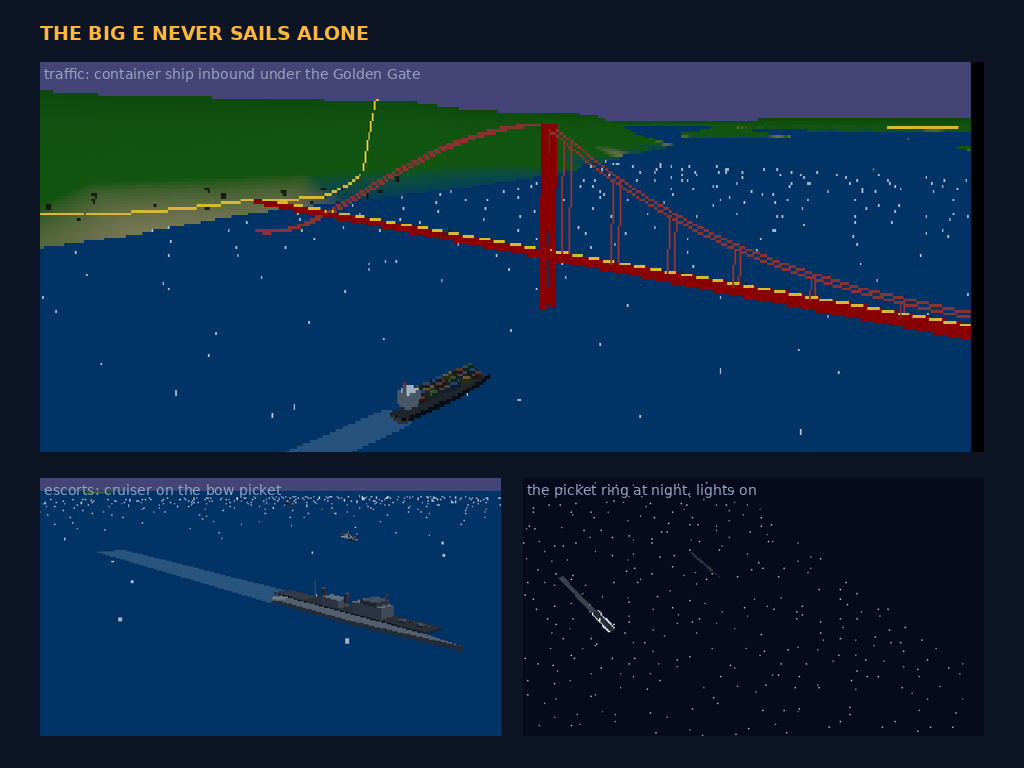
The Enterprise is the flagship of a carrier battle group, and now she sails like one. Four escorts hold a picket ring around her at all times: a guided-missile cruiser 2.4 km ahead, two destroyers 1.5 km out on each beam, and a frigate 2.8 km astern (far enough back to keep your final approach clean). Each escort is a proper station-keeper with its own helm — when the Big E reaches the end of her patrol leg and puts the rudder over, the ring swings with her, the outside ships sprinting to their new stations before settling back to formation speed. All five ships are procedural low-poly builds in the game's flat-shaded style, with wakes that trail astern and running lights that come on at night.
The bay is alive now too. Two container ships loop a shipping lane between the Pacific and the central bay, passing under the Golden Gate twice per circuit (inbound lane north, outbound lane south, like real traffic keeping right). Fishing boats work the grounds off the Marin coast, the waterfront and Richardson Bay, while sailboats and a little motor cruiser crisscross the bay between the city front, Alcatraz and Angel Island. Every route was validated against the game's own ground-truth terrain — the first draft beached two sailboats on Telegraph Hill, which is how the bay pilots learned their charts. Twelve ships total, all steaming day and night.
The Bay Area highways carry live traffic now — cars glued to the asphalt in their lanes (no more driving on the grass), over roads painted with center dividing lines and lane dashes, draped over the terrain including the bridge decks.