Last week the stores callouts were re-cut from a synthesizer in the name of one-voice consistency — one larynx, but the wrong larynx. The mail was unambiguous: bring back the buzzy squadron-radio baritone that has read the panel since the beginning. Consider it done. All six callouts are back from the original lossless masters, and the set speaks with a single voice again — the right one this time.
The originals are untouched.GUN, SIDEWINDER, AMRAAM, PHOENIX and SPARROW are the same recordings you know, lifted straight from the masters — not re-reads, not lookalikes.
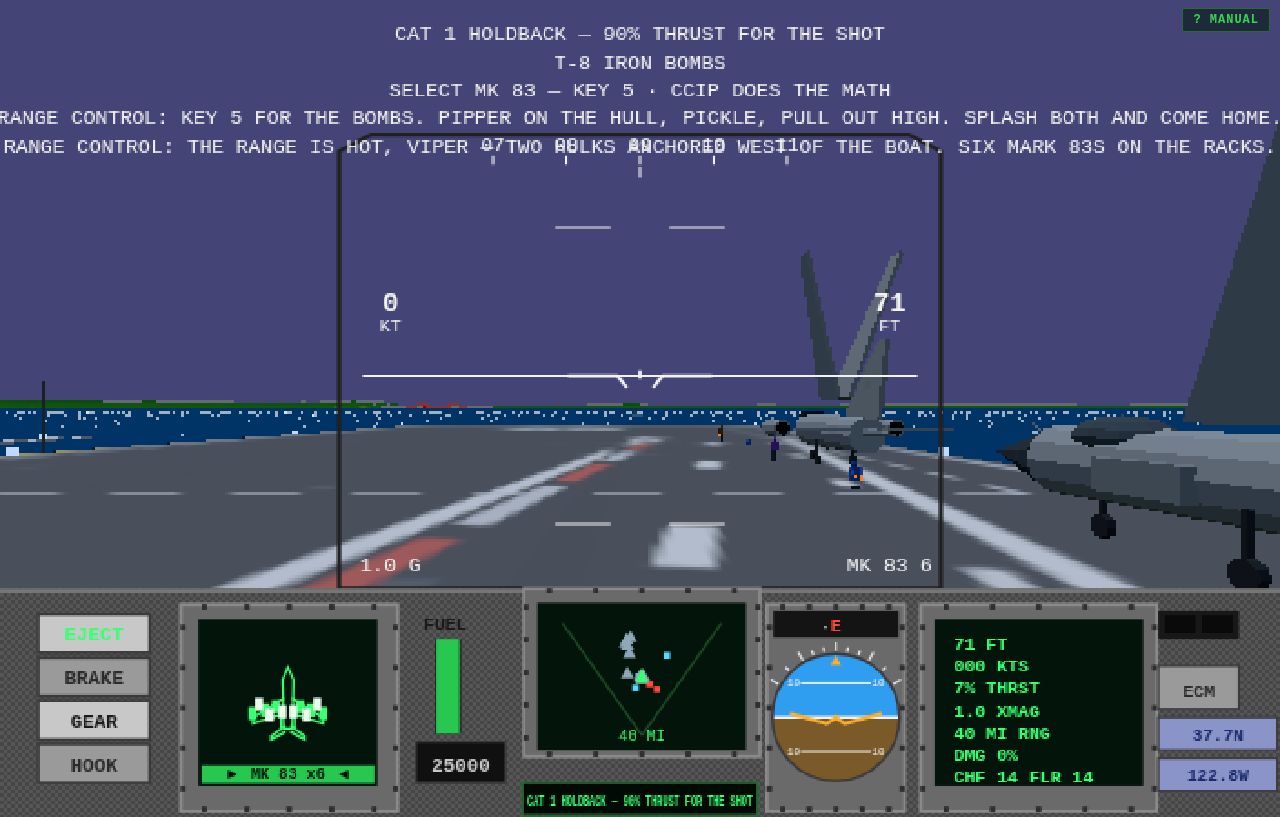
The bombs say BOMBS. The strike ring’s newest voice used to read the label like a tech order — “Mark eighty-three”. Nobody on an intercom talks like that. Select the iron and the jet says one word: BOMBS.
One voice, on the record. The rule is now written into the project brief: every store that joins the ring gets cut from the same voice, or it doesn’t ship. Consistency breaks are twice bitten.
Cycle the ring on the cat and the jet reads the panel to you — in the voice you remember. — HB
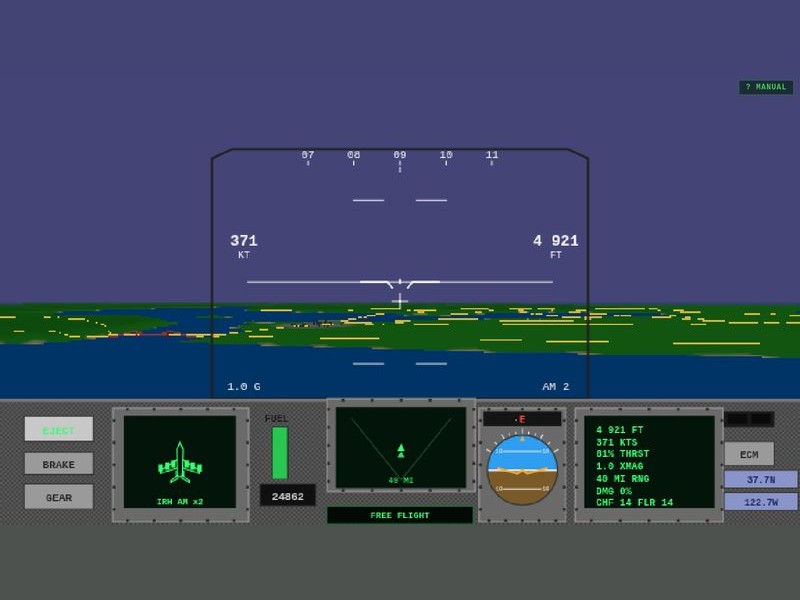
ENTER a new weapon and the jet answers out loud again. The spoken stores callouts — GUNS, SIDEWINDER, AMRAAM, PHOENIX — were pulled a while back in the name of 1988 purism: one console beep fits all. Purism lost the argument. In a dogfight your eyes are on the bandit, not the panel, and a one-word answer from the intercom beats a beep that could mean anything.
Two new voices join the roster. The Tomcat’s medium stick now announces SPARROW, and the strike missions answer MARK 83 when the bombs ride the ring — both cut on the same bench as the originals, the same buzzy squadron radio baritone, so the six sound like one crew.
The beep keeps its job as understudy. While the samples stream in — or if one ever goes missing — the classic console beep still answers the toggle. Once the voices are aboard, they own the call.
Six words, one per weapon, never when you didn’t ask. Cycle the ring and the jet reads the panel to you. — HB
Out with the static. Every call on the net used to arrive with a squelch click, a burst of band-passed garble doing its best impression of a voice, another click — and then the browser would flatly read the words aloud. On a busy frequency that was a lot of noise riding over the engines and the wind.
The text stays. Tower calls, SCREWTOPS picture reports, your wingman checking in — they all still print to the message ticker and the data-link strip at the bottom of the panel. You lose nothing you needed to know.
The sound goes. The squelch-and-garble synth and the speech-synthesis read-aloud are both removed outright — not a toggle, not a volume slider, gone. The mix is engines, wind, weapons and the deck now.
The Enterprise is quieter tonight. Read the ticker, fly the jet. — HB
Radio messages used to arrive the way telegrams do — silent text at the top of the windscreen, easy to miss with a bandit on your nose. Not any more. Every call on the frequency now announces itself the way real traffic does: the squelch clicks open, a burst of band-passed garble rattles off with a voice’s cadence, and the squelch drops shut behind it. You hear the net before you read it.
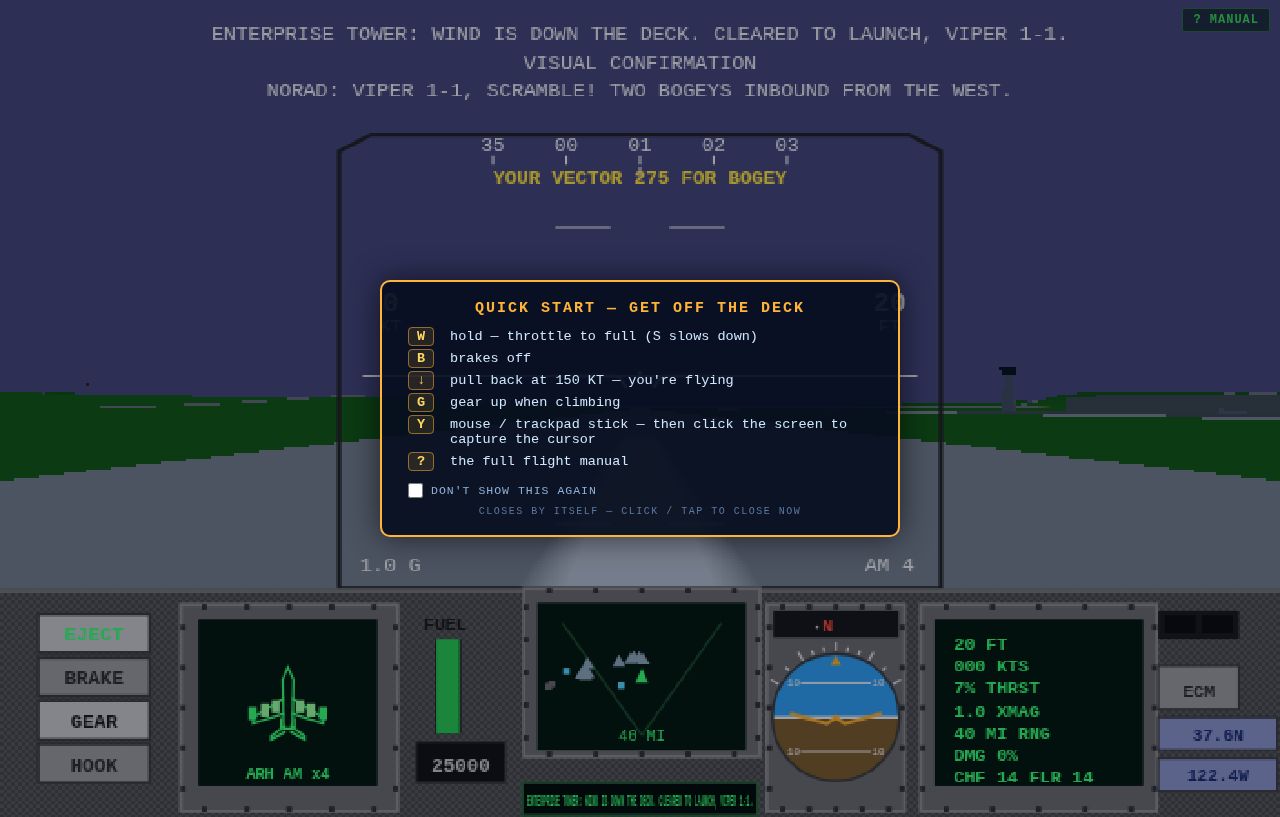
And where the browser has a voice aboard, the call doesn’t stop at static — it speaks the line itself, flat and fast, the way a controller actually reads it: the tower clearing you to launch, NORAD vectoring you onto the bogeys, SCREWTOPS calling VAMPIRE VAMPIRE, the LSO talking you down the groove. Headset on, eyes out of the cockpit.
One hook, whole net. The chatter rides the single message rail inside the sim — anything posted to the frequency (tower, AWACS, NORAD, instructors, range control, wingman check-fires) crackles on arrival, no matter which system keyed the mic.
Synthesized, not sampled. The squelch-and-garble burst is built live in the WebAudio graph out of shaped noise — three to six syllables, randomized cadence — so no two calls sound quite alike and nothing had to be recorded.
The voice has manners. Spoken lines come from the browser’s own speech engine, pitched down and paced up like a busy controller; callsigns read the way they’re said (“Viper 1-1” comes out “one one”), and a fresh priority call cuts the queue rather than backlogging the frequency. Where speech isn’t available, the chatter alone still carries the cue.
Between this and the recorded weapon callouts, the cockpit finally sounds the way a fighter’s headset feels: somebody is always on the net.
The player looks the same, but what comes out of it isn’t: the little square-wave synth band has stood down, and the Hornet Bay Anthem is now the full studio recording — three and a half minutes, no repeats — on every page outside the cockpit.
Still a seamless loop. The file is trimmed to the music — the hundred-millisecond hush at the head and the two seconds of tail silence are gone — and it loops sample-accurate through the WebAudio path, so the final bar falls straight back into the first with no gap, ever.
Same manners as before. One click anywhere wakes it (browser rules), STOP is remembered across visits, and the anthem still stands down the moment you launch a sortie — the sim owns the soundscape in the air — then strikes back up when you’re home at the menu.
Our own anthem. The borrowed Star-Spangled chiptune is struck. In its place: the Hornet Bay Anthem — an original sixteen-bar march written for the bay, square-wave lead over a root-and-fifth bass, looped forever with zero silence at the seam — the final note releases exactly as the downbeat of the next lap attacks. Same player, top-right: play, pause, stop.
The cat shot, restaged. Night on the waist cat: it opens astern of the Hornet, burner lit, and the camera swings a wide right-hand orbit around the launch until it’s dead on the nose — looking straight back down his pipe with the Enterprise island glowing in the background.
The go-fast shoots back. The gun-run scene cuts to a chase view from astern of the charging boat — and she’s not running silent anymore: a mounted machine gun hammers back at the Seahawk, tracer rising past the lens while the helo’s own bursts walk down the other way.
Shipboard launches whoosh. When the Klakring lets an SM-1 or a Harpoon off the rail you hear it leave — the same whoosh the VLS and the shoulder-launched shots always had.
The Hog gets the right voice. The A-10’s twin TF34s are turbofans, and now they sound like it — the Hawg scene and any A-10 you spectate in-game sing the high turbofan whine instead of the fighter howl.
One click wakes the sound, as ever — then the march plays the bay in, and it never bumps at the loop.
Twenty-four scenes now, and the loop finally sounds like the bay looks. The rundown:
The reel found its voice. Every scene pipes the sim’s own soundscape to the menu — props whirring on the P-3 and the helicopters, afterburners roaring on the cat shot and the downtown run, the rotary cannon’s brrrt in the gun scenes, the missile’s whoosh off the rail, and honest splashes when the torpedoes and sonobuoys hit the water.
The anthem has a player. An original Hornet Bay anthem — a chiptune march, looped seamless with no gap at the seam — plays behind every page outside the cockpit — homepage, flight log, store, the lot — with its own player top-right: play, pause, stop. Stop remembers you mean it. Launch a sortie and the anthem stands down — the sim owns the soundscape in the air — then it strikes back up when you’re home at the menu.
Air Force One takes the lap. A full 360° with the zoom breathing all the way round — an F-15 riding each wing, opening on the rear quarter and finishing on the nose.
The prowler gets tracked from above. The camera flies the P-3’s circle high over the enemy boat — the whole kilometre of her profile sliding by below, tightening as it wheels, the way you’d mark her from altitude.
Two Seahawk set pieces. The torpedo run: on station, flare wall, Mark 46 away with the retarder chute cracking open, wake racing for the hull — and the water comes up at the beam. Then the door gun: a go-fast charges the gun line while the right-hand gunner walks his bursts onto it, and the cut drops you on the bow with the tracers ripping past overhead.
The group brings its pilot home. Ejection to recovery in one unbroken scene: the canopy floats down, the alert Seahawk bends on, holds station overhead, winches him up to the door and turns for the boat — rider still on the wire as the deck fills the frame.
BEST PLAYED ON COMPUTER. It says so right under the title now — and if you arrive on a phone it says so again, centre-screen, before anything else. Throttle, stick, weapons: bring a keyboard and a mouse.
One click anywhere on a page wakes the sound — browser rules, not ours. Refresh, listen, and watch the rescue.
Two dials turned this push, one for your patience and one for your ears:
The warp ladder grows two rungs.Z now climbs 2x · 4x · 8x · 16x · 32x before dropping back to normal. Sixteen and thirty-two are for the long hauls — the inbound leg from the far waypoint, the air wing’s full pattern cycle, waiting on a trap queue. The whole world steps with you: traffic, helicopters, the carrier’s steam, all of it.
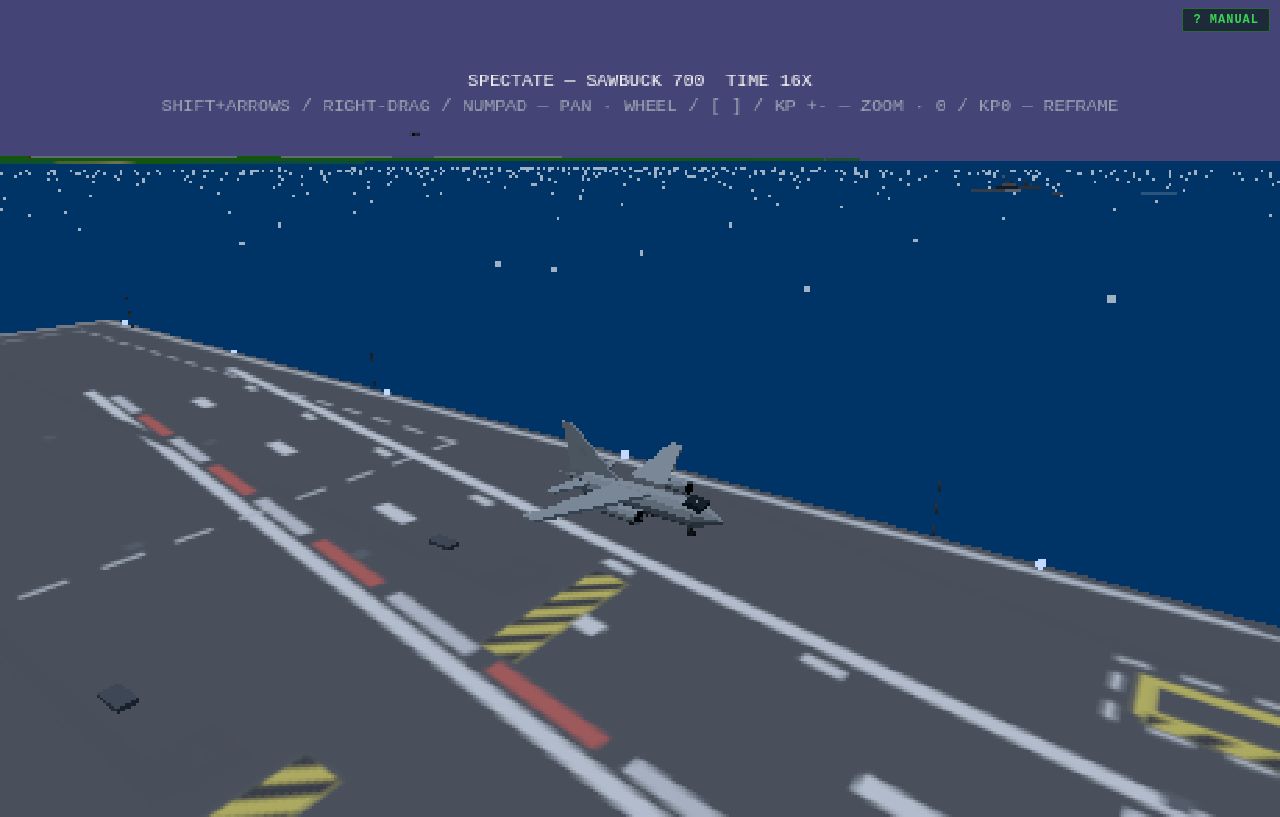
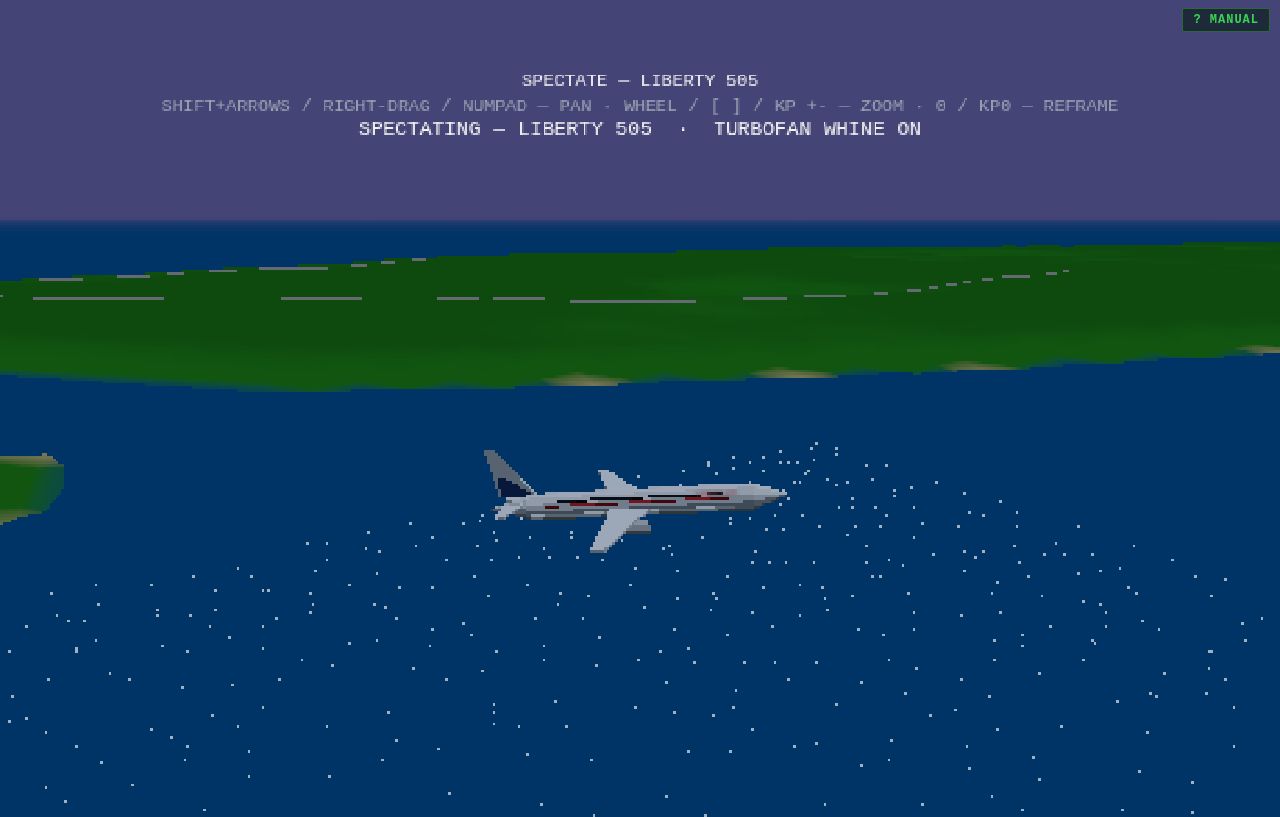
The S-3 sings turbofan now. Sharp ears caught it: the Viking is no prop — she runs a pair of TF34 turbofans under those wings. SAWBUCK 700 now gets the airliner voice in spectate (J), the high synthesized whine instead of the prop whirr. The C-2 keeps the whirr (hers are honest turboprops), the A-6 keeps the jet loop, and every other ride is unchanged.
Spectate mode (J) used to be a silent film. Now every aircraft you ride sounds like itself, three voices crossfaded by type:
Jets — the Hornet, Tomcat, Viper, Eagle, Warthog, MiG, Flanker and the air wing’s jets — reuse the recorded Amiga engine loops, pitch following speed.
Airliners get a turbofan whine, synthesized fresh: two detuned high sines over a band of compressor hiss that rises with speed. Ride a Liberty 737 up the approach and it sings exactly like the cheap seats.
Props get a whirr — the E-2, the C-2 and the P-3, plus all four helicopters: twin blade-pass saws beating against each other the way two turboprops do, over low rumble.
Ships, the carrier and missiles stay quiet — some rides have no engine note to give.
Notifications come with you. Important messages — radio calls, trap calls, warnings — now print on-screen under the spectate title instead of staying home in the cockpit bar. They ride on-screen in the cockpit view too, no longer confined to the little strip in the panel.
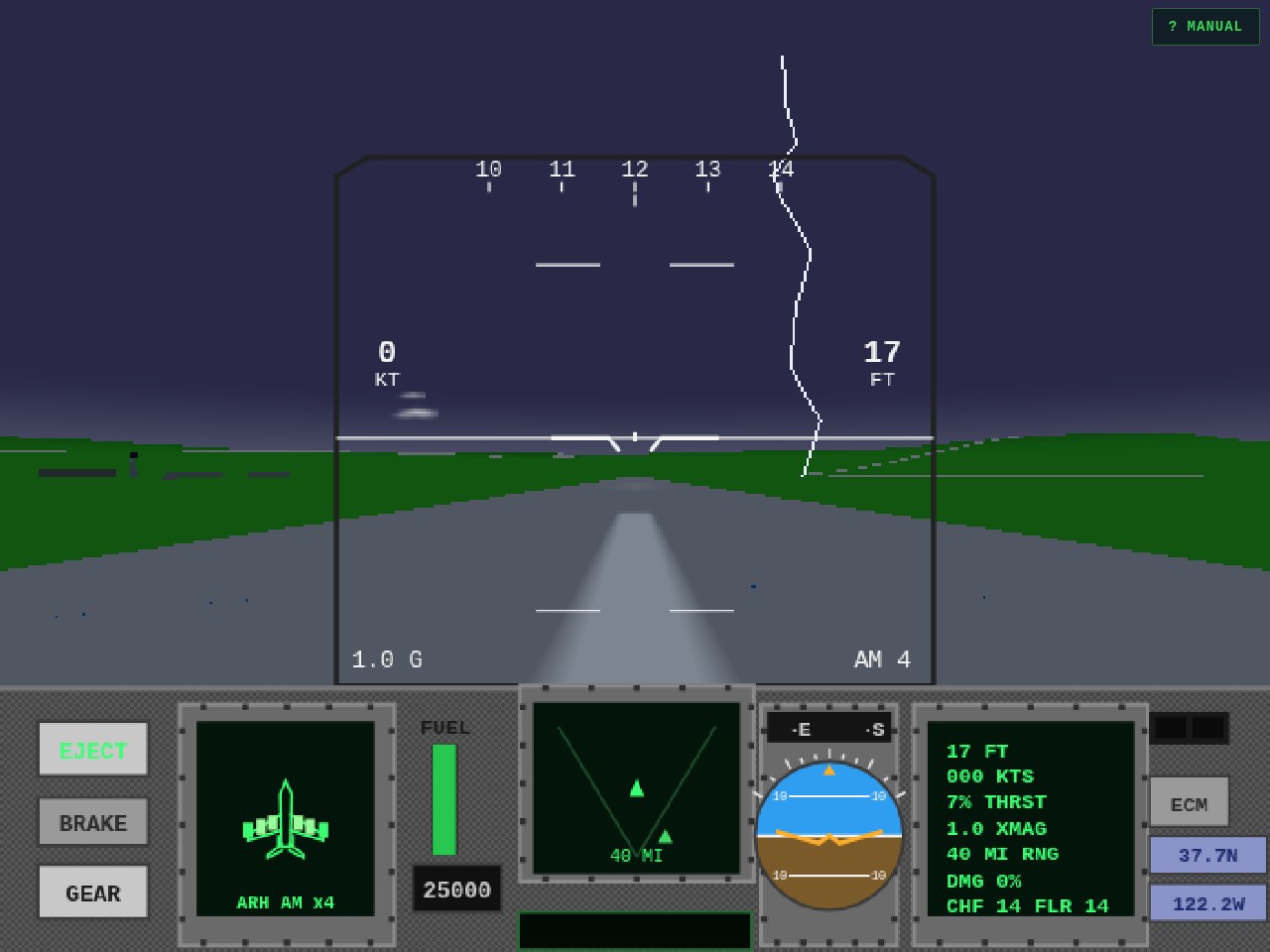
The R toggle just grew a full weather ladder. Where it once flipped CLEAR/RAIN it now steps through five states — MISSION DEFAULT → CLEAR → CLOUDS → RAIN → STORM — on the main menu, on the plane-select map, and saved between visits:
CLOUDS breaks the original’s cloudless sky — the scattered sprite deck that ships with the sim finally gets to fly, fading in over a couple of seconds with a light dimming of the day. Everything eases; nothing pops.
RAIN implies overcast now — the streak rain you know, under the cloud deck, with the usual gloom dragging the murk in close.
STORM brings the lightning. Every few seconds a jagged channel bolt walks down out of the deck somewhere within a few miles, the whole sky answers with a cold blue-white flash, and the thunder arrives late — delayed by true distance at 343 m/s, a crack decaying into a long low rumble through the audio graph.
Clouds got their own weather channel — separate from the rain blend, so overcast days can exist without a drop of rain, and every state fades smoothly through the same sky/fog/sun gloom the rain always used.
Manners kept: satellite planning maps stay free of rain, murk and bolts; pausing still silences the sky; and missions you authored stay exactly as clear as you left them — MISSION DEFAULT never surprises you.
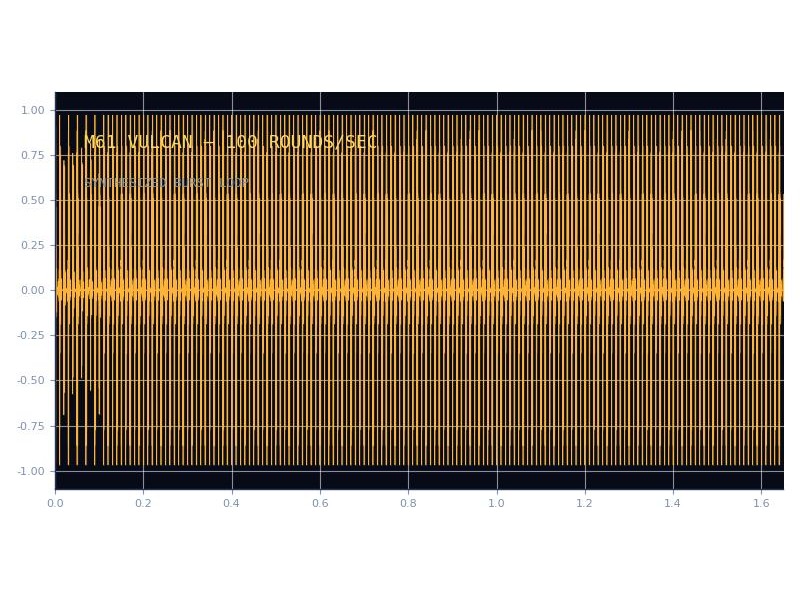
The gatling sample is rebuilt to match the real M61: a 100-rounds-per-second burst synthesized from scratch — powder-crack impulse train, mechanical roar, and the fire-rate ripple that gives the Vulcan its buzzsaw shriek. YouTube was unreachable from the build sandbox, so the sound is synthesized to the reference rather than lifted from the video.
Hold the trigger on the gun and she sings: a proper A-10-style BBBBRRRRR gatling roar loops for as long as the burst lasts, then cuts when you let off. And cycling weapons with ENTER now gets you a spoken callout — GUNS, SIDEWINDER, AMRAAM — so you always know what's live without looking down.