HORNET BAY
FLIGHT LOG
← ALL ENTRIES
#SHIPS — 3 ENTRIES
SHIPSWORLD

The Big E — USS Enterprise (CVN-65), the home plate you launch from
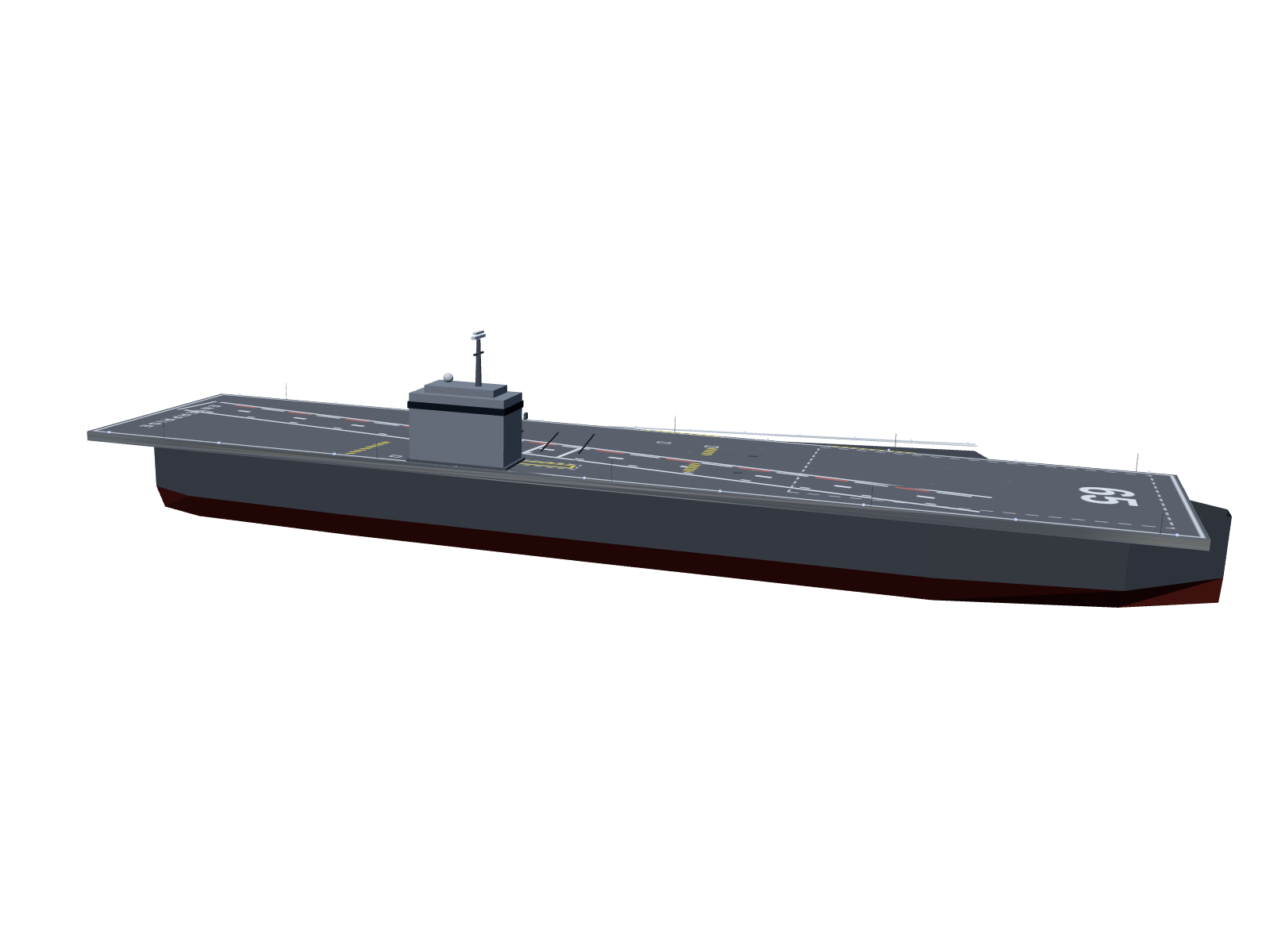
Low three-quarter view of the grey USS Enterprise carrier model on a white background: flat deck with angled landing strip markings, a boxy island with a mast, and a large white 65 painted near the stern end.

The Big E is where every Hornet Bay sortie begins and ends: a 342-metre angled-deck carrier with Cat 1 reserved for you, Cat 2 for the air wing, and a meatball guiding you to the 3-wire.

Every sortie in Hornet Bay starts and, if you follow the rules, ends in the same place: a 342-metre slab of grey steel doing a steady course through the bay. The Print Bay lists her at a real length of 342 m, and she is the one ship in the sim that matters more than any other, because she is your point of origin.

What you are standing on

USS Enterprise was the Navy’s first nuclear-powered carrier, commissioned in 1961. In the sim she is the home plate: a flat-top with a boxy, flat-roofed island and a landing strip angled off to port, as covered in the angle deck post and the island rebuild. The hull number, 65, is painted big on the deck.

In the sim

Escorts and a model for your desk

She never sails alone. Four station-keeping escorts hold a picket around her, and the cruiser ahead is also in the Print Bay, along with the Big E herself: scaled to 250 mm long, six angles of her on the shelf.

One standing rule applies, and it is the reason she matters: a mission only counts as complete when you return to the point of origin. Land at another airfield and you can rearm and refuel, but you still have to come home.

Try this: take off from the carrier, circle once, then fly the break and put the meatball in the centre of the row. Do it three times and you will never look at a runway the same way.

— HB
The escorts report their names: Gettysburg, Nicholson, Stout, Klakring 86ef63b

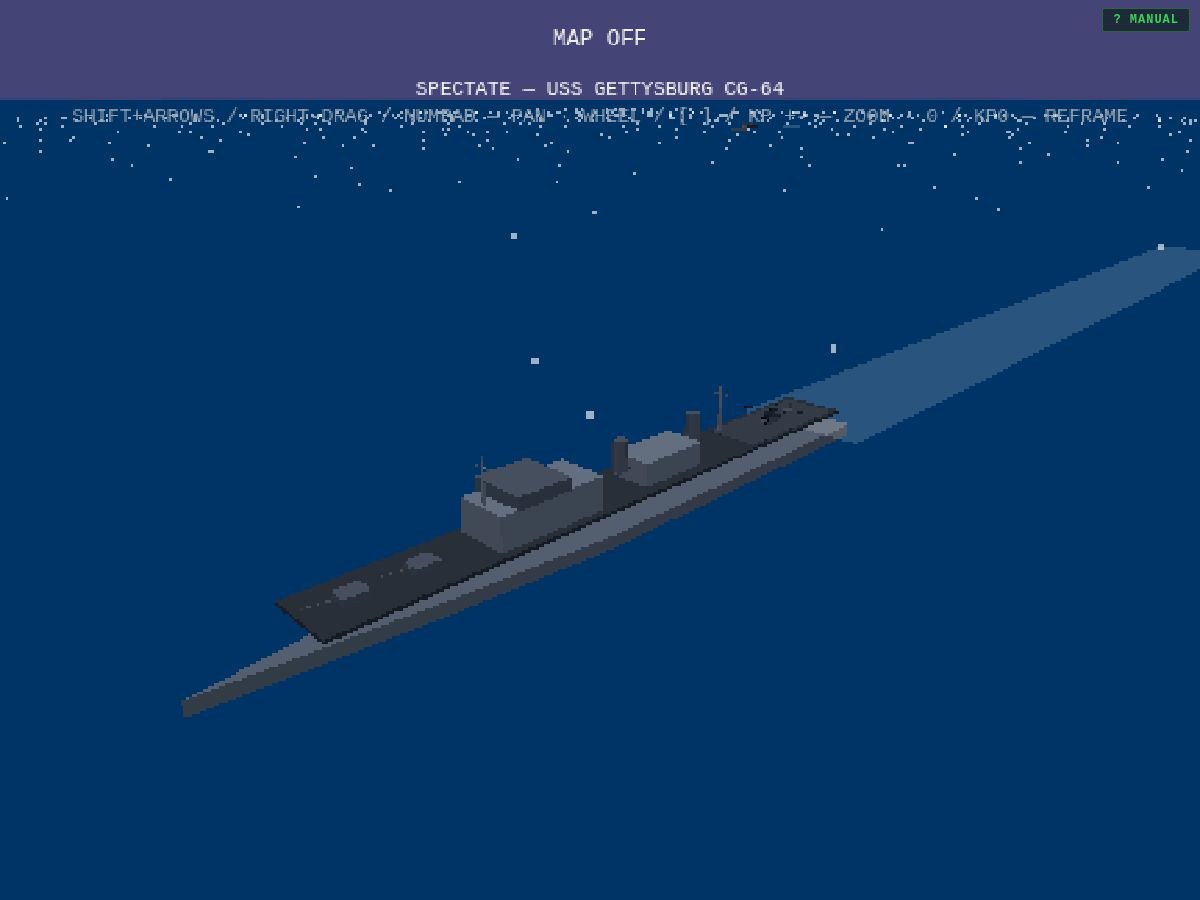
FEATURESHIPS USS Gettysburg CG-64, Ticonderoga-class cruiser, in spectate view — two turrets, two funnels, wake trailing

“GUIDED-MISSILE CRUISER” was never going to cut it. The four escorts of the battle group now sail under their own names — chosen from the ships that actually shepherded the Big E through her mid-90s:

  1. USS Gettysburg (CG-64) — Ticonderoga-class Aegis cruiser, holding the van 2,400 yards ahead. Gettysburg rode shotgun on the carrier’s 1996 return to sea after the long refuelling, and kept the station for years.
  2. USS Nicholson (DD-982) — Spruance-class destroyer on the port beam. Another repeat consort, from the ’96 cruise through Desert Fox.
  3. USS Stout (DDG-55) — Arleigh Burke-class guided-missile destroyer to starboard, named for Rear Admiral Stout and present in the ’98 group.
  4. USS Klakring (FFG-42) — Oliver Hazard Perry-class frigate as the astern picket, parked well clear of the approach so your final stays sacred.
  5. The sourcing: the November 1998 Navy Wire battle-group list for Enterprise reads Gettysburg, Stout, Nicholson, Klakring almost verbatim — the closest real formation to our 1994, when the Big E herself was finishing her refuelling overhaul. Alternate history, accurate consorts.
  6. Where you’ll see them: the tactical map (N) labels each hull by name, the radar paints them as steel-grey triangles, and J spectates them too — the banner reads the name back at you, as in the shot above.

The Big E never sails alone: battle-group escorts and bay traffic 67a2c7f

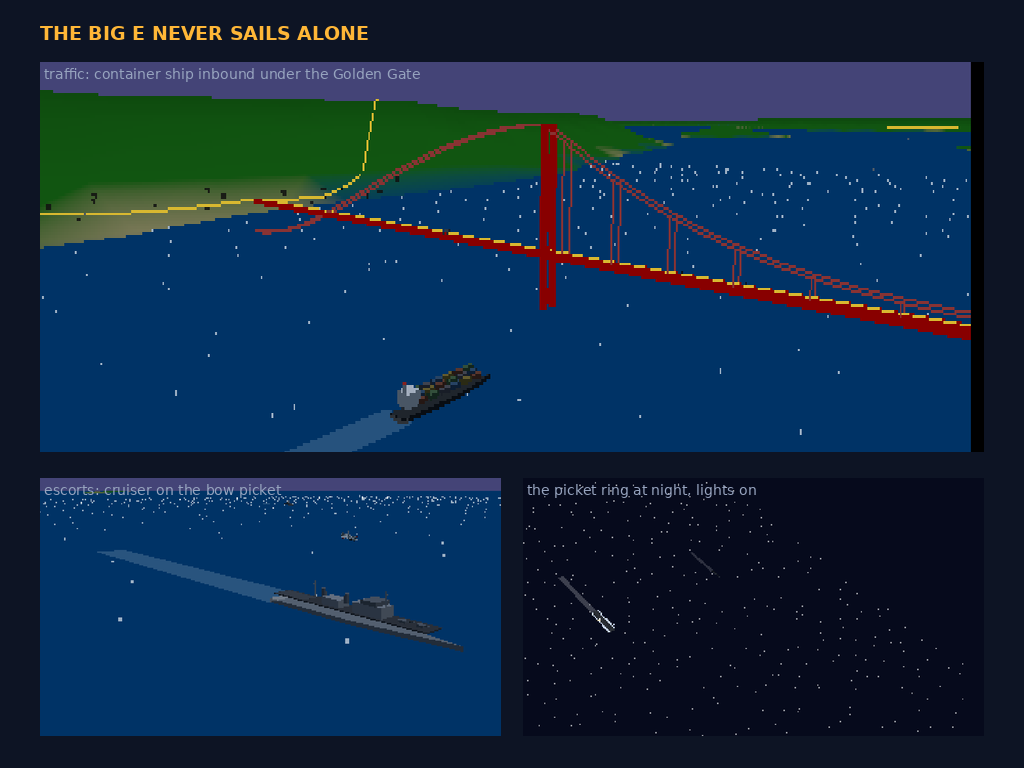
WORLDSHIPS A container ship steaming under the Golden Gate, a cruiser on the bow picket, and the escort ring at night

The Enterprise is the flagship of a carrier battle group, and now she sails like one. Four escorts hold a picket ring around her at all times: a guided-missile cruiser 2.4 km ahead, two destroyers 1.5 km out on each beam, and a frigate 2.8 km astern (far enough back to keep your final approach clean). Each escort is a proper station-keeper with its own helm — when the Big E reaches the end of her patrol leg and puts the rudder over, the ring swings with her, the outside ships sprinting to their new stations before settling back to formation speed. All five ships are procedural low-poly builds in the game's flat-shaded style, with wakes that trail astern and running lights that come on at night.

The bay is alive now too. Two container ships loop a shipping lane between the Pacific and the central bay, passing under the Golden Gate twice per circuit (inbound lane north, outbound lane south, like real traffic keeping right). Fishing boats work the grounds off the Marin coast, the waterfront and Richardson Bay, while sailboats and a little motor cruiser crisscross the bay between the city front, Alcatraz and Angel Island. Every route was validated against the game's own ground-truth terrain — the first draft beached two sailboats on Telegraph Hill, which is how the bay pilots learned their charts. Twelve ships total, all steaming day and night.