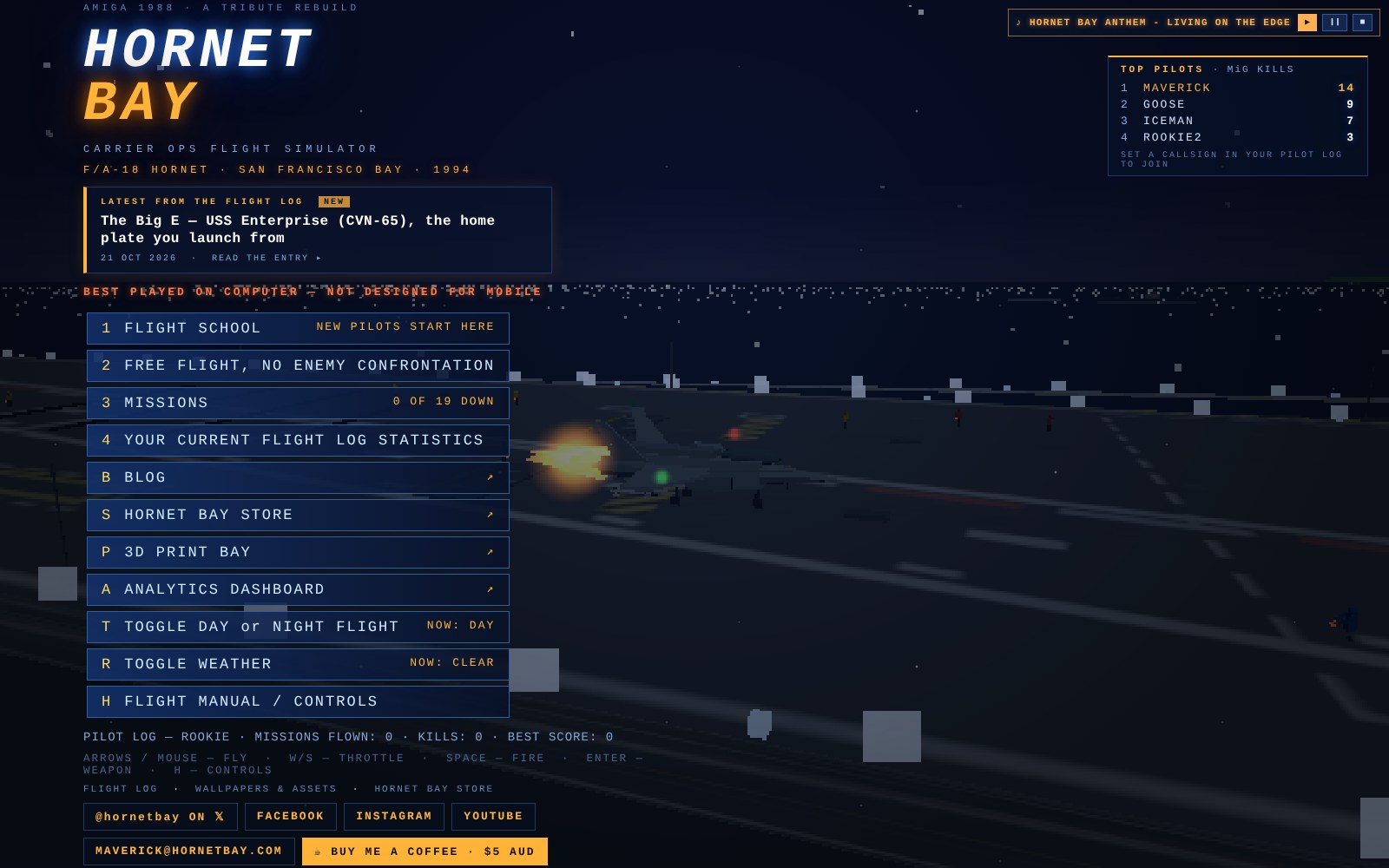
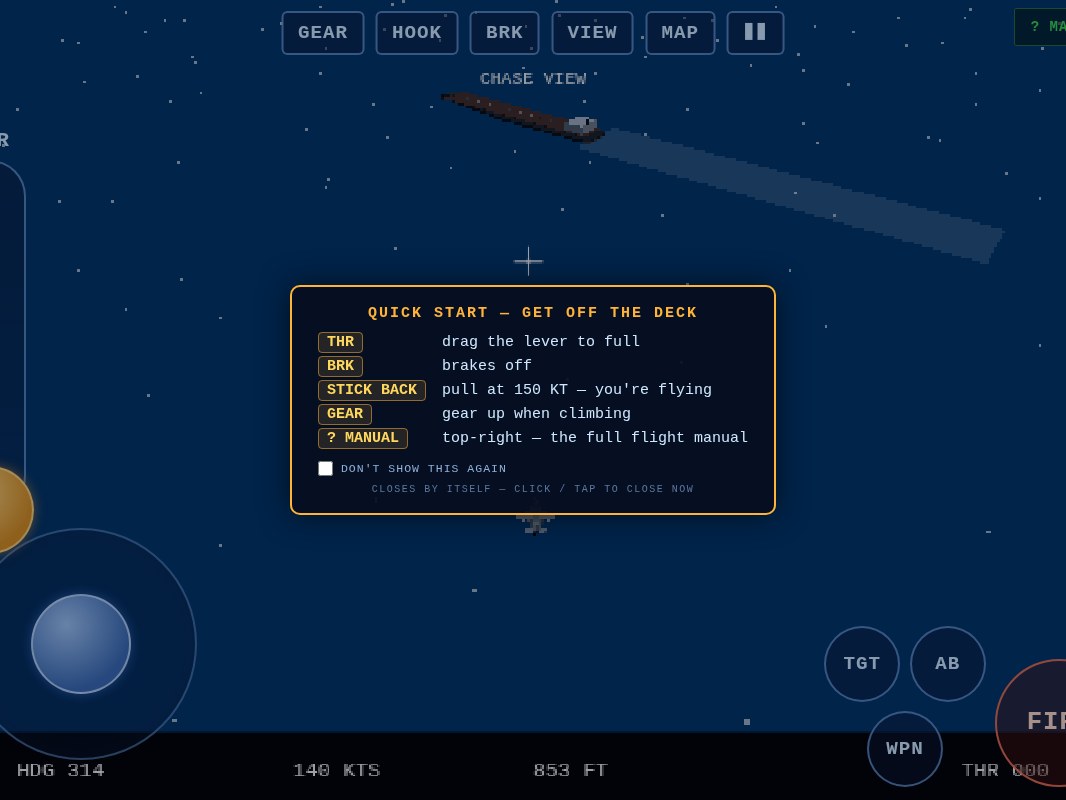
The title screen now has a leaderboard: TOP PILOTS, ranked by MiG-29 kills. Set a callsign in your pilot log, splash a MiG, and your name goes on the board.
Until now the front door only showed fleet-wide totals. That tells you the Bay is busy; it doesn't tell you who is winning the fight. The new panel sits top right on the title screen and lists the five pilots with the most MiG-29 kills, with the leader in gold.
How it works
Opt in with a callsign. You only appear once you set a callsign in your pilot log (menu option 4). Stay ROOKIE and nothing about you is sent.
Only MiG-29s count. It uses the same counter as the fleet strip's Bogies splashed tile: bandits you shoot down yourself, not wingman kills, and never airliners.
What is shared. Callsign and kill count, plus a random id so two pilots named MAVERICK don't merge. The id is never shown. The board is client-reported, so treat it as bragging rights, not a tournament record.
Your own line. If you are in the top five, your callsign is underlined.
The screenshot above uses sample callsigns; the live board fills in as pilots earn their places. If the leaderboard service is unreachable the panel shows the last board your browser saw, or hides itself rather than showing an error.
Try this: set your callsign from the pilot log, fly a sortie and take down a Fulcrum. New to the sim? Start with flight school; the fleet totals strip is explained in By the numbers.
Hornet Bay has a lot of metal in it now. Before we start taking it apart one airframe, one squadron and one hull at a time, here is the whole roster: what flies, what sails, what shoots, and who you meet in the Bay. It also kicks off something new: an article every day for the next 90 days.
YOU FLY
Five flyable jets. The F/A-18 Hornet, F-14 Tomcat, F-16 Falcon, F-15 Eagle and A-10 Thunderbolt II. The Hornet and the Tomcat trap aboard the Big E; the F-16, F-15 and A-10 are land-based and fly without a tailhook.
28 sorties. Eight flight-school sorties, a 19-mission campaign that runs from a visual ID to a nuclear-tipped cruise missile sprint for the city, and free flight over the Bay by day, dusk or night.
THE HOME TEAM
The air wing. USS Enterprise (CVN-65) works a 1994 Pacific air wing around the clock: an A-6E Intruder of VA-52 Knight Riders, an S-3B Viking of VS-37 Sawbucks and a C-2 Greyhound of VRC-30 Providers, with an E-2C Hawkeye of VAW-123 Screwtops watching the Bay from above. See Around the clock.
The escorts. USS Gettysburg (CG-64), USS Nicholson (DD-982), USS Stout (DDG-55) and USS Klakring (FFG-42) hold the picket ring. See The escorts report their names.
The Bay itself. Freighters and tankers on the shipping lanes, a cruise ship, fishing boats and yachts, airliners on approach to SFO, and a P-3 and Seahawks hunting a shadow submarine.
THE OTHER SIDE
The opposition. MiG-29s and Su-27s that actually dogfight, Tu-95 Bear bombers, cruise missiles, a Kilo-class submarine, go-fast boats and gunboats, and shoulder-fired Igla missiles waiting on the freighter decks.
THE ARMOURY
Yours. Sidewinder, Sparrow, Phoenix and AMRAAM, a gatling gun and Mk 83 bombs.
Theirs and the fleet’s. The R-27 and R-73 on the Russian jets, and the SM-1 and Harpoon that Klakring fires back with.
EVERY DAY FOR 90 DAYS
From tomorrow the Flight Log runs a weekly rhythm, and every post lands at a different hour of the day:
Mondays: the squadrons. The units behind the airframes.
Tuesdays: the aircraft. One airframe at a time, in numbers.
Wednesdays: the ships. Starting tomorrow with the Big E herself.
Thursdays: the weapons. Every round in the armoury.
Fridays: the sorties. Walkthroughs from flight school to the campaign.
Saturdays: the workshop. How Hornet Bay is built, sounds and prints.
Sundays: the long read. One story, properly told.
Every model in this roster also lives in the 3D Print Bay: 37 of them. Keep the RSS feed handy so the daily posts find you. — HB
Three site chores landed in one sweep — one visible alignment fix, one clickable banner, and a full dress uniform for every journal link you share:
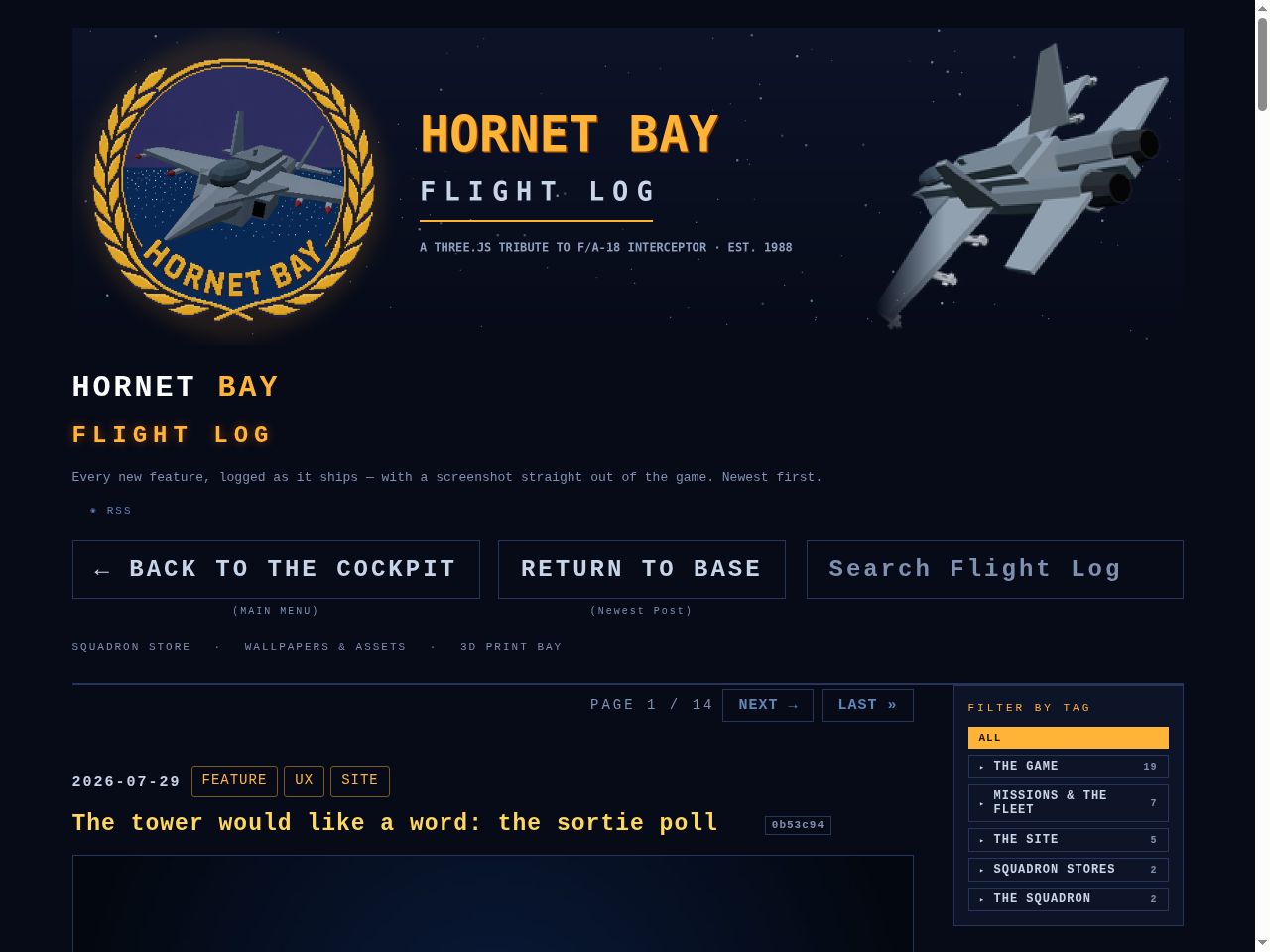
The search box is back in formation. Search Flight Log rides the same row as BACK TO THE COCKPIT and RETURN TO BASE — 59 pixels to 59 pixels, tops aligned — while the squadron-store links keep the row below to themselves. Phones stack the lot, search full-width.
Every post now ships its cards. All 134 journal entries carry an optimised meta description (cut at a sentence where one fits, 155 characters budget), a complete Open Graph card — image with its true pixel dimensions read off the file, secure URL, type, alt text, locale, published time and one article:tag per squadron — and a complete Twitter card: summary_large_image, site and creator @hornetbay, a title trimmed to 70 characters, and alt text on the image. Drop a link anywhere and it arrives in dress uniform.
The banner flies home. The laurel header on every one of the 212 pages is now a link back to the homepage, with a soft amber glow when you hover it. One template, one shared stylesheet, one sweep — every page born from here on carries it.
Found and fixed in the sweep: four old headlines carried spliced markup from an ancient hash-stamp — one title duplicated mid-word, four wearing two hash badges. All repaired, and the rebuild now audits every page: descriptions under 160, Twitter titles under 70, no exceptions.
Thirty-five tags was a roster, not a filing system. The flight log’s sidebar now squadrons up — five parent categories with the child tags tucked into sub-menus — and a little menu housekeeping flew the same sortie:
Five squadrons, every tag assigned. THE GAME (19 tags: FEATURE, CONTROLS, BUG FIX, SIM, the whole flying machine), MISSIONS & THE FLEET (7), THE SITE (5), SQUADRON STORES (2) and THE SQUADRON (2). Parents show their child count and open an accordion of chips — one squadron on the board at a time, each child carrying its post count.
The rail still flies the same. Clicking a child filters exactly like before, the parent lights amber when one of its own is on the board, and a #tag= link auto-opens the right squadron — search and paging are untouched.
Duplicate spellings merged. FIX and BUGFIX both become BUG FIX — 37 tags down to 35 and one spelling from here on. The old flat tag strip stays in the markup for the crawlers but no longer takes up the page.
Same sortie, lighter menu. GALLERY has left the main menu — spectate view does its job now — and the ANALYTICS dashboard page is retired (the counters still tick quietly in the background). The social chips on the menu footer and every blog footer are bigger, bolder, and a lot easier to hit.
A big batch of small doors and corridors this time — plus one very big grey hull:
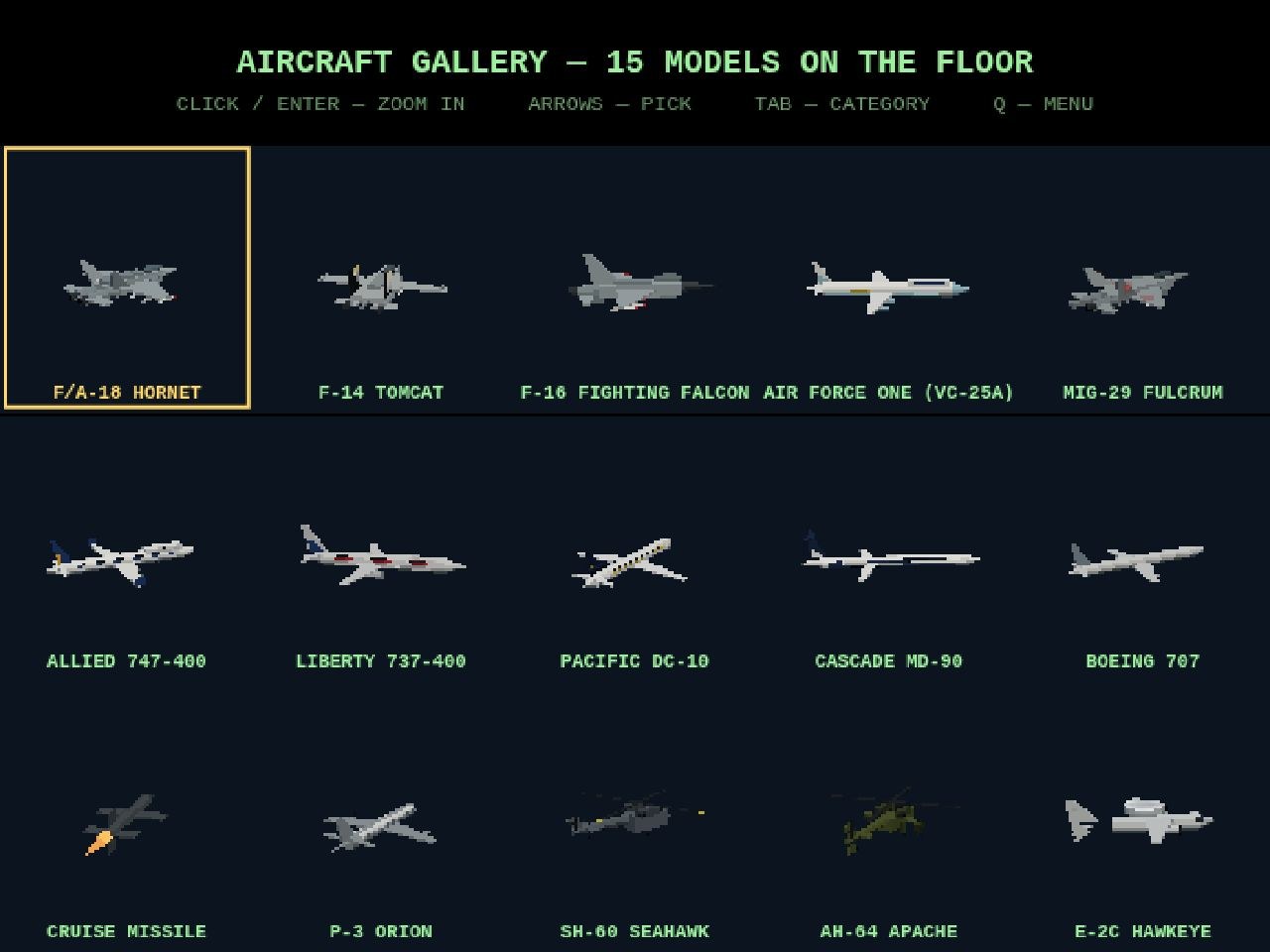
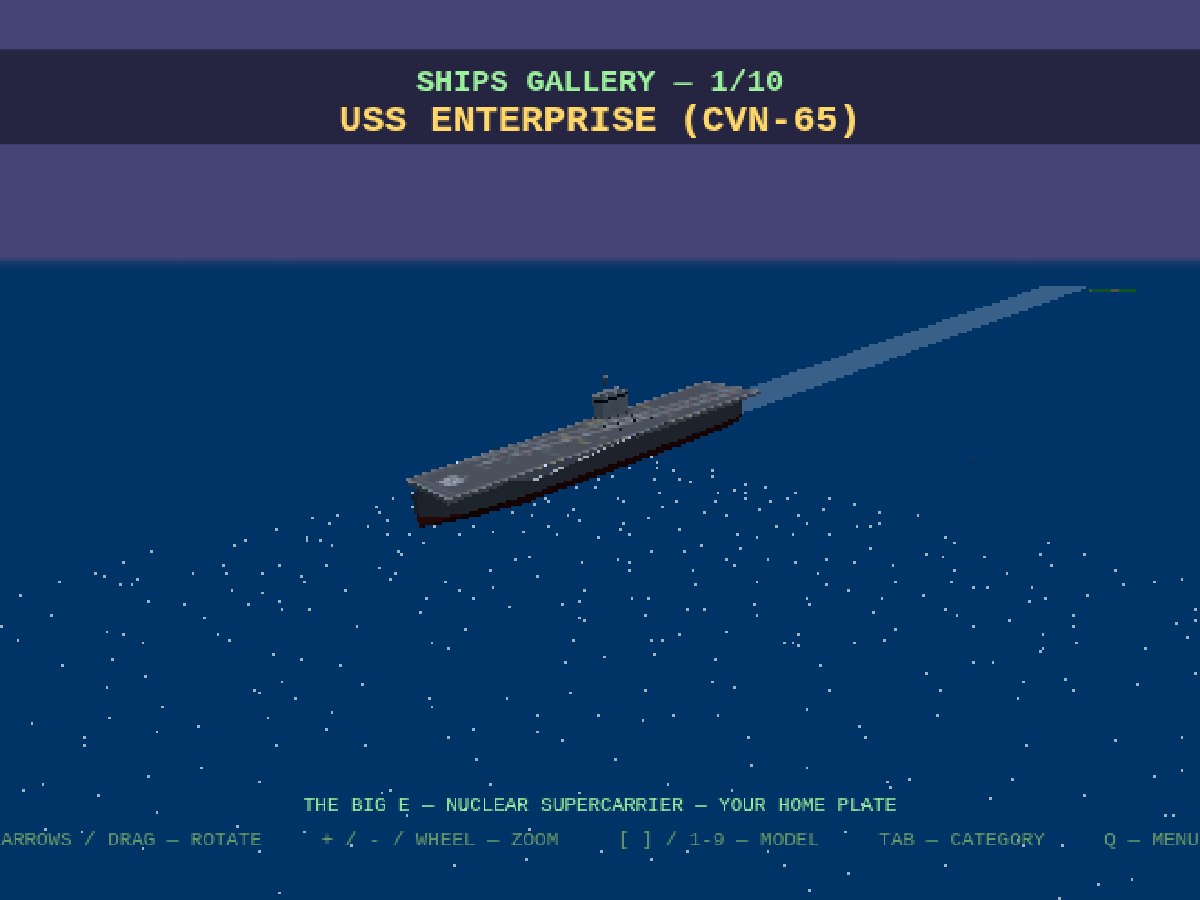
The gallery now covers every aircraft and every ship in the game. Eight airframes and ten hulls: the Big E, her cruiser, destroyer and frigate escorts, MT PETRO PACIFIC, MS BAY MONARCH, MV BAY TRADER, and the fishing boat, sailboat and motor cruiser that clutter the weekend lanes.
It is split into two categories — AIRCRAFT and SHIPS. TAB jumps between them; [ ] or 1–9 still step through the exhibits, and every model remembers its own sensible viewing distance.
SELECTABLE MISSIONS is now simply MISSIONS, and NEXT ACTIVE ADVANCED MISSION has left the menu — the missions speak for themselves.
BLOG is a main-menu item (key B, opens in a new tab), and the homepage link is retitled to match.
HORNET BAY STORE is a main-menu item (key S, new tab) — the old Exchange link is retitled too.
Every blog tag is now a page. Each tag chip links to its own stub — /blog/tag/ships and friends — and the blog carries a tag sub-menu up top, so you can read by topic: FEATURE, CONTENT, SHIPS, SITE and the rest.
One housekeeping note: from now on, every model screenshot you see here comes straight from the gallery — and any new model that joins the game joins the gallery at the same time.
The shipping lanes between the Bay and the Pacific have gone heavy. Four new hulls now work the lane in both directions — three deep-laden supertankers and a cruise liner — each one named and typed in the traffic system, each trailing a wake scaled to its length. Meet the new traffic, largest first:
MT PETRO PACIFIC — 360 m overall, 54 m beam, 3.5 kt on the lane. The biggest hull in the bay; she barely answers her helm.
MT GOLDEN CRUDE — 340 m, 50 m beam, 3.8 kt. Black hull, rust-brown deck, pump manifold amidships, accommodation castle right aft.
MT ATLANTIC BULK — 320 m, 48 m beam, 4.0 kt. The sprinter of the tanker trio — which, granted, is not saying much.
MS BAY MONARCH — 230 m, 30 m beam, 6.8 kt. The cruise liner and the fast mover of the lane: stacked white decks, window bands, and the line’s amber band on the funnel.
Seamanship notes: after dark all four show proper lights — white masthead, red to port, green to starboard — and every hull leaves a wake you can pick out from altitude. They share the water with the existing freighters, fishing boats and yachts, so the Golden Gate is properly busy now.
One word to the wise, pilots: file these names away. The mission desk has been asking an unusual number of questions about lane schedules of late — best to know a supertanker from a cruise liner before the tasking orders start mentioning hulls by name.
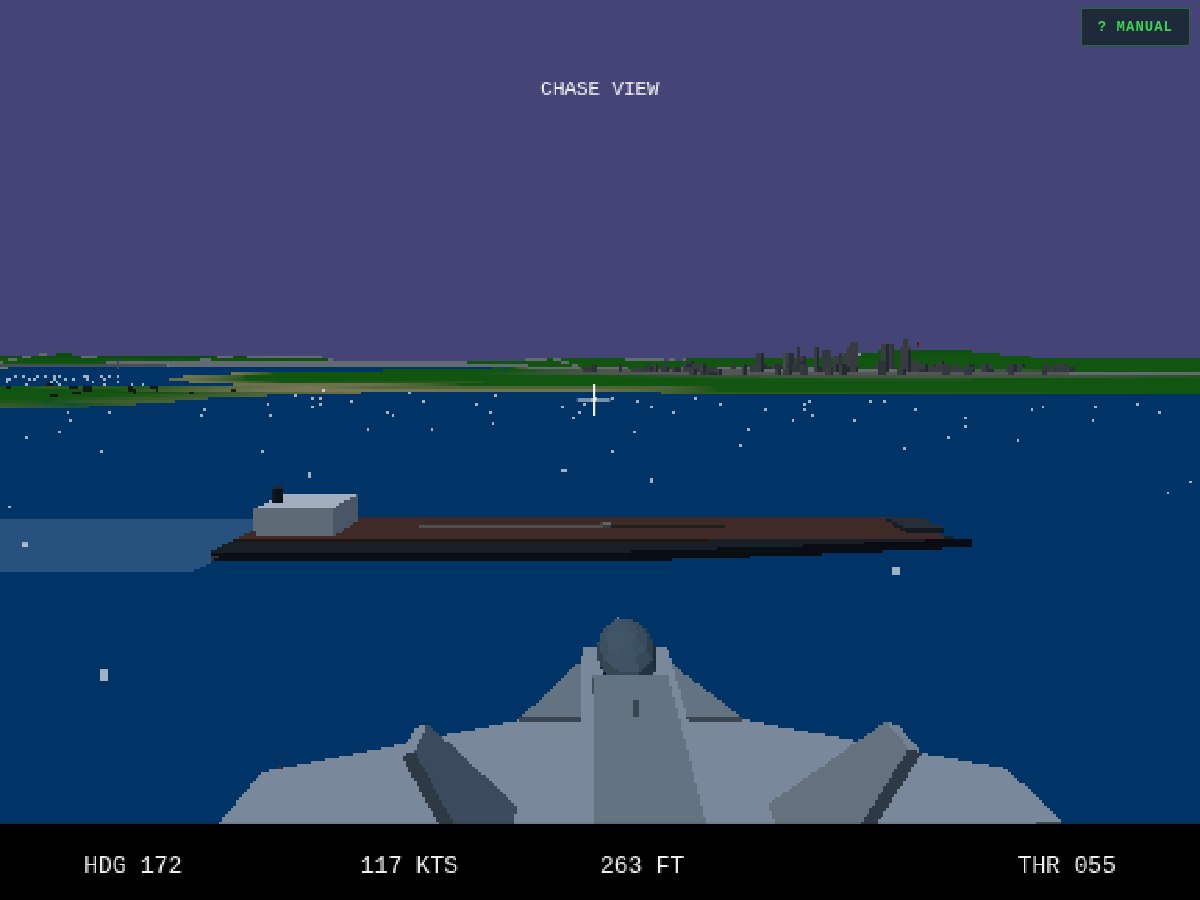
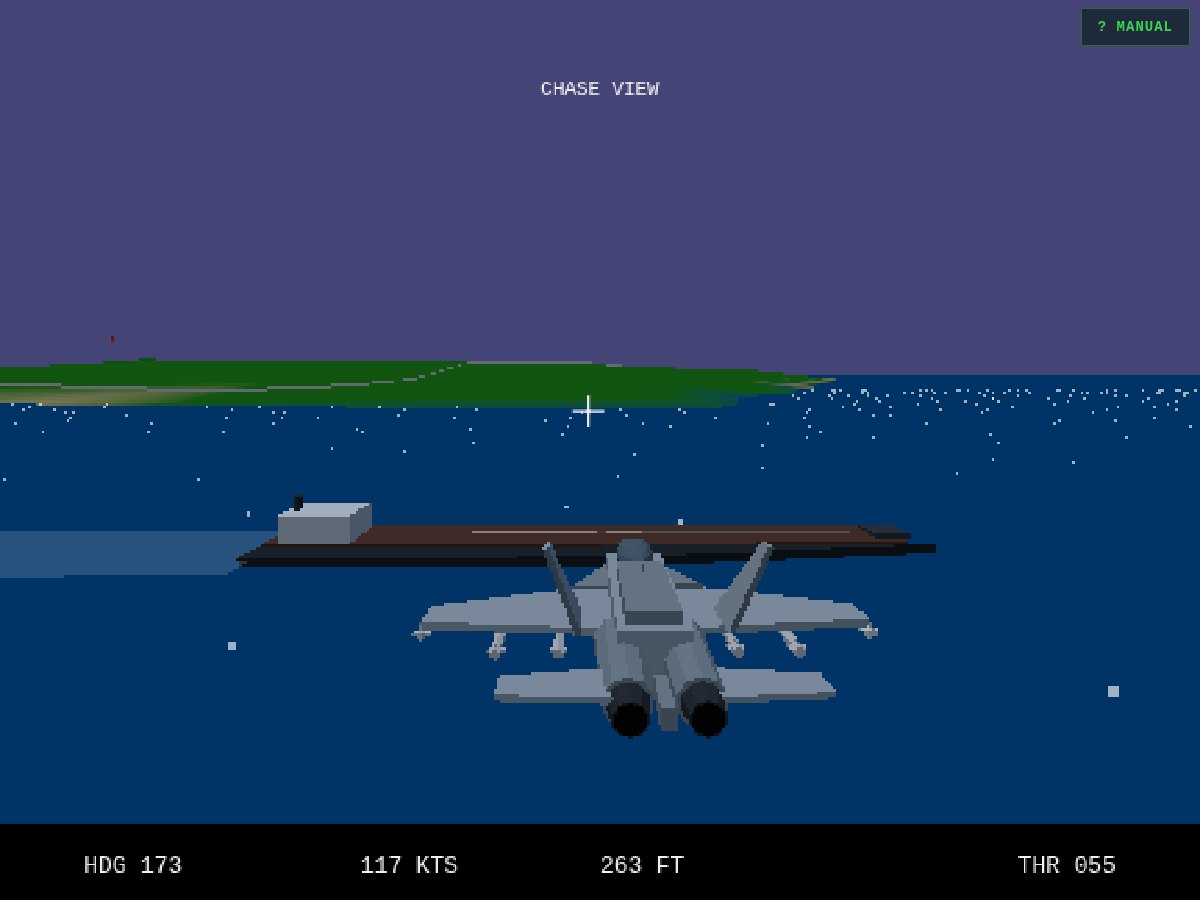
View system overhaul: V now cycles cockpit → cockpit-off → chase → orbit → tower. Cockpit-off is the pilot’s-eye view with full symbology and no glass or panel in the way. Spectate (J) no longer shows your own jet or the cockpit furniture while you ride along — just a clean SPECTATE banner, and X drops you straight back into the cockpit. The F1–F10 throttle row has been retired from the flight manual (the bindings themselves are untouched), and the title screen now reads Carrier Ops Flight Simulator.
The shipping lanes are getting heavy: three supertankers — MT PETRO PACIFIC (360 m), MT GOLDEN CRUDE (340 m) and MT ATLANTIC BULK (320 m) — plus the cruise liner MS BAY MONARCH now ply the lane between the Bay and the Pacific. All four are named and typed in the traffic system, ready to be tasked in future missions.
Brand desk: the Squadron Laurel roundel has been re-shot — the complete Hornet now appears from the original emblem’s camera angle, whole airframe inside the ring. Files on the assets page.