The Sidewinder is the round for the fight that has collapsed to a few kilometres: 850 m/s, the tightest turn rate on the rail, and an infrared seeker that flares can still fool.
Every pilot in the sim carries the Sidewinder, and every pilot eventually learns what it is for: the fight that has already collapsed to a few kilometres, where the radar rounds are too slow to turn and the gun is too late.
Where it came from
The real AIM-9 was led by Dr. William B. McLean at the Naval Ordnance Test Station, China Lake. An experimental round was first fired on 21 August 1952 and flew the wrong way; the first successful launch followed on 9 January 1954. Its first combat kill came on 24 September 1958, when a Chinese Nationalist F-86F pilot downed a MiG-17 near the Formosa Strait. The principle never changed: passive infrared homing, a seeker that simply follows hot exhaust and emits nothing for the target to detect.
The AIM-9 by the numbers (in the sim)
- Top speed: 850 m/s, accelerating at 320 m/s².
- Turn rate: 3.2 — the tightest of the Western rounds; the AIM-120 manages 1.9, the Sparrow 1.6.
- Seeker: infrared. It cannot be jammed by chaff and does not need your radar to hold a lock.
- Motor and life: 2.2 seconds of burn, 22 seconds in the air.
- Loadout: two on the Hornet and Hawg, and two ’Winders on the F-14 alongside its Phoenixes and Sparrows.
Why it wins knife fights
That turn rate is the whole story. At close range the Sidewinder out-pulls nearly anything it is chasing, and unlike the Sparrow it does not need you to keep a lock once it is away. The trade-off is that a heat-seeker is only as good as the heat it is looking at: a flare dropped inside 1,500 m has a 75% chance of fooling it, and a hard break at close range can shake it too. Flares beat IR. Chaff beats radar. Knowing which is which keeps you alive; the stores callouts tell you what is on the rail.
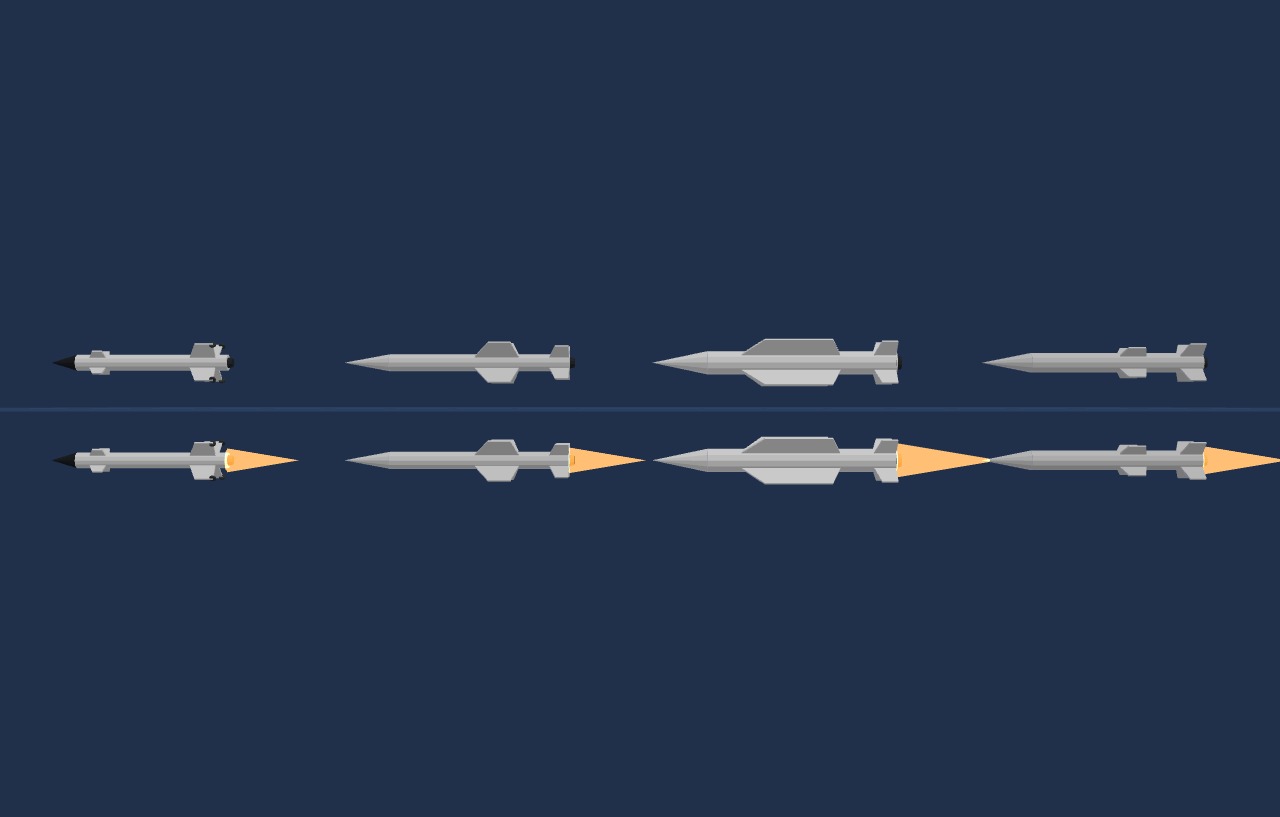
The round now looks the part, too: fins, nozzle and a live exhaust cone while the motor burns, as seen in the lineup above (the Sidewinder is the one on the far left; the others are the AIM-120, Phoenix and Sparrow). Each body is in the Print Bay if you want one on your desk.
Try this: cycle to AIM-9 with ENTER, fire with SPACE, then hit F to drop flares the moment a bandit shoots back — and note how quickly 22 seconds runs out.
— HB
The armory went back to school. Until now the air-to-air family flew as painted tubes with a red cone glued on — recognizable only by the label on the HUD. Put the reference photography on the bench and the differences are glaring: a Sidewinder is not a Sparrow is not a Phoenix. Now they aren’t.
- Every round wears its own fins. The Sidewinder gets its dark seeker dome, nose canards and the rolleron wheels on the tail tips; the Sparrow its mid-body deltas; the Phoenix its fat motor and long strake wings; the AMRAAM its clipped fins. The Soviet and shipboard rounds got the same treatment.
- Rocket fire out the back. A launched round now burns — a live exhaust flame off the nozzle and a thick white ribbon while the motor runs, then flame-out and a thin drifting trail as it coasts. Each type burns for its own motor time; a Phoenix burns like a Phoenix.
- The swing wing found its voice. The Tomcat’s gloves used to travel in silence. Press S and the hydraulics answer — steel on tracks as the wing moves between 20° and 68°.
Fox three and watch it go: fins, fire, and a proper smoke column off the rail. — HB
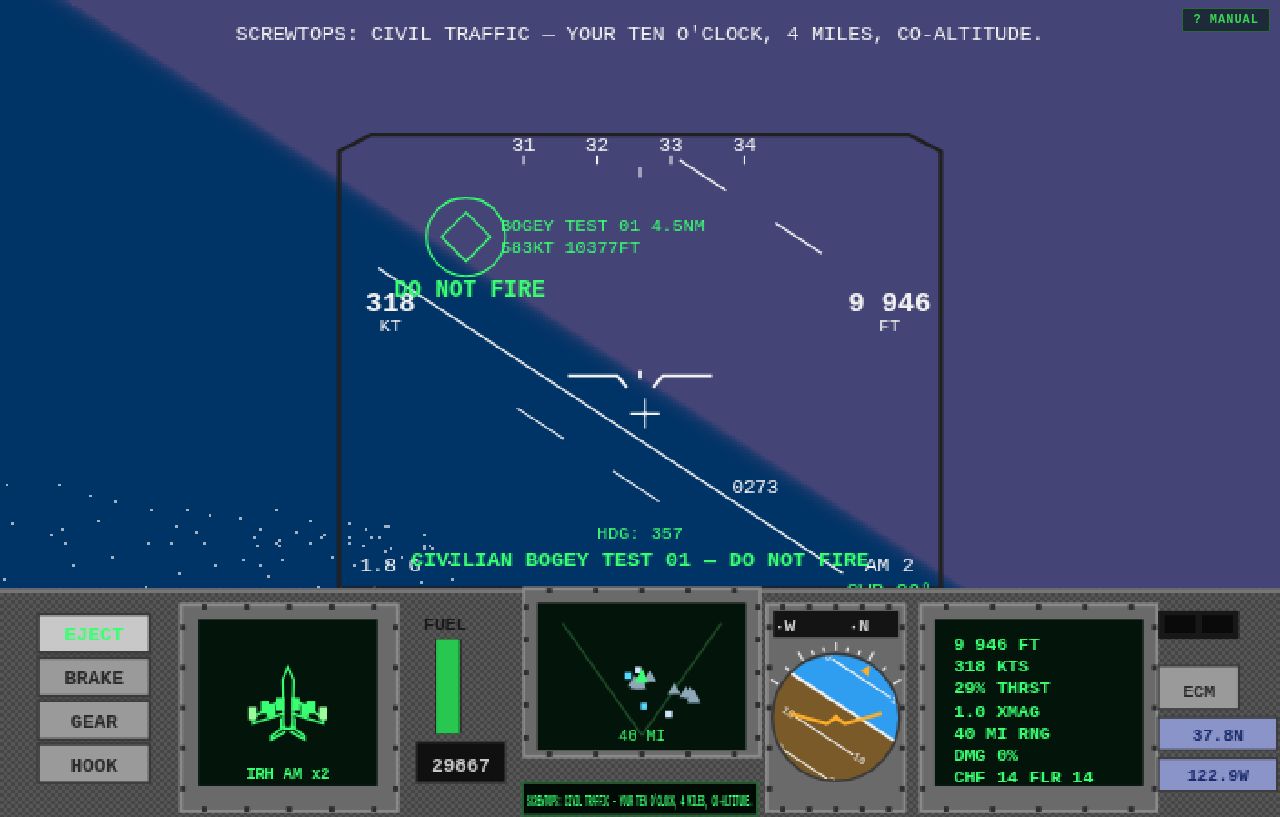
Two rules of the air war are now painted right on the glass. First: this is an air-to-air fighter — the lock system simply will not offer a firing solution on surface contacts. The shadow sub and the raft are still out there on the scope, and the gun still settles arguments with them, but the T-key no longer tones up anything sitting on the water.
- Green means hold. Civilians, friendlies and unidentified bogeys can still be acquired — you have to track a contact to identify it — but the diamond, the lock circle, the off-screen arrow and the banner all paint green, with a flashing DO NOT FIRE advisory at full lock. Hostiles lock up red with SHOOT, exactly as before. Friend from foe is now a glance, not a memory test.
- The Tomcat carries the Sparrow. The F-14's 1994 fleet fit is modeled for real: two Phoenix, four AIM-7M/P Sparrows, two Sidewinders. The Sparrow reaches past 25 km and hits harder than a 'Winder — but it is semi-active: FOX 1, then hold your radar lock all the way in. Break the lock for more than a heartbeat and the round goes ballistic — SPARROW LOST — RADAR LOCK BROKEN.
- Fire-and-forget has a price. The AIM-54 lets you crank away the moment it leaves the rail; the AIM-7 asks you to stay pointed at the bandit and eat the closure. Pick your shot: Phoenix for the sniper work, Sparrow when the merge is coming and you can afford the commit.
Four Sparrows, one rule: the lock is the weapon. — HB